
When the nights draw in and the evening air feels chilly, those of us who have log burners, open fires and log stoves are thinking about stocking up the log store shed for winter. There’s nothing cosier and more relaxing than sitting in front of the flickering flames of a log burner, sharing some stories and precious times with the family, that is, if you can get the fire lit! And that means getting the log store shed prepared for easy access.
Burning wood begins with the right log store shed
The key to successful fires is choosing the right kind of wood and storing it correctly. Here are some handy tips:
- Dryness: Dry wood will burn hotter and cleaner, with less smoke, so how you store your wood is important. Ideally, the moisture content needs to be below 20% and the logs will have been Kiln-dried.
- Density: The denser the wood, the more effective the fire will be. Hard woods burn hotter and for longer, providing more efficient heat. Hard woods include ash and oak. Softer woods like pine will burn through more quickly, though fires made of pine tend to be easier to light.
- Ignition: As just mentioned, you’ll find that some woods are much easier to light than others. Ash and birch are great woods to use because they light quickly and burn for a long time, which is the perfect combination.
- Smoke: Pine and other conifers contain more sap and resin, which can increase the amount of smoke produced by a fire.
- Ease of splitting: Of course, if you’re chopping up logs yourself, you may prefer to choose soft wood rather than hard wood for ease of splitting.

Stacking wood in a log store
How you stack your wood supply is important. It’s vital to let the air flow between the pieces of wood. So, arrange logs in rows with small gaps between each log. This will ensure that the wood is seasoned and dry before you burn it on your fire.
Always raise your log pile so it’s off the ground. If you don’t have a tailor-made log store, place the logs on pallets or bricks, and put a waterproof covering over the top of the pile, leaving the sides open to allow the air to flow between them.
Log store shed ideas
At Forest Garden, we have several log store sheds to choose from, depending on your individual needs. They vary in size, but they all allow logs to be stored under cover, and they let air circulate between the logs. Log stores with a roof and open sides are always recommended as these are the perfect conditions for keeping firewood.
We have some simple log stores in stock, such as our Compact Pent Log Store – 126.2cm (h) x 96cm (w) x 82.3cm (d) – which is small enough to place in a handy position near your backdoor: Compact Pent Log Store – Forest Garden.
Our Large Overlap Log Store – 191cm (h) x 272cm (w) x 87cm (d) – allows you to store a lot more wood in perfect conditions. The log store’s felted, boarded roof and overlap side panels ensure that logs are protected from the elements, while the open front allows air to circulate freely: Large Overlap Log Store
Some of our log stores are true log store sheds and come with a useful tool shed attached, saving space in your garden and keeping it free of clutter. This Large Overlap Log/Tool Store is constructed from heavy-duty, pressure-treated timber and is designed to last for years: Large Overlap Log/Tool Store


Finally, Forest Garden makes larger sheds with lean-to storage areas on the side, like this 4LIFE Apex Shed 6×8. This spacious log store shed allows you to keep garden tools, a mower and pots inside. But the covered outside storage area can be used either for bulky items like wheelbarrows or as an ideal log store: 4LIFE Apex Shed 6×8 – Double Door – No Windows – With Lean-To – Forest Garden.
Whichever log store shed you choose, now is the time to stock up on wood for your fire. We hope you enjoy many cosy firelit evenings over the cooler months.
Looking for thoughtful gifts for gardeners in the UK? Choosing the perfect present for birthdays, Christmas, weddings or retirements isn’t always easy, but if your loved one enjoys spending time in the garden, you’re in luck. From practical tools to relaxing garden furniture, there are plenty of brilliant gifts for gardeners that they’ll truly appreciate.
Here’s all our gift ideas for gardeners
- A special plant is always a lovely gift. Opting for a beautiful shrub like a camellia, ceanothus, lilac or hydrangea can brighten up any garden or outdoor space. Of course, you’d need to know a bit about your loved one’s preferences, the kind of soil in their garden and how much space they have before selecting a shrub, but plants last a long time and can bring so much joy. Hydrangeas are always at the top of our list.


- Garden tools make a great gift for enthusiastic gardeners. Trowels, forks, spades and kneelers are all useful items to consider. Trowels have a habit of going missing in gardens so always make brilliant gifts for gardeners. And gardening gloves are always happily received.
- If you’re really struggling for gift ideas, a garden gift token can solve the problem easily. Most garden centres sell tokens that can be used throughout the UK. Tokens make a good present for gardeners who like to go and choose a plant or a garden tool themselves, and it’s a great excuse for a trip out to the local garden centre!
- A pretty pot to grow a plant in can add colour to a patio area or driveway. It’s ideal for smaller gardens that lack the space for flower beds. Choose a pot that’s large enough to allow the plant to grow, with drainage holes at the base.
- At Forest Garden, we have a choice of sturdy wooden planters to add to the list of ideas, which are long-lasting and attractive. Our Linear Planter (Square) has sleek, modern lines. It holds approximately 49L of compost, so plants can get their roots down and thrive.
And for more gifts for gardeners from our range:
- Our Linear Planter comes in many sizes (double, long, tall and with wheels) and looks stunning when planted with an array of herbs or flowers. Decorative shrubs such as box and miniature firs look amazing too. Our planters come with a 15-year anti-rot guarantee.
- Our Slatted Wall Planter is original and stylish. This contemporary planter attaches to a wall and is perfect for anyone who wants to design their own living plant wall. It’s also great if you’re lacking space in your garden.


- Many gardeners find our Potting Bench both practical and appealing. It can be used for potting up your plants and for storage as it has a useful shelf for keeping your tools and pots. This is a brilliant present for gardeners who want to keep their outdoor space tidy.
- For people who like to entertain, especially in the summertime when the weather is good, our Fold Down Wall Garden Bar is bound to create a buzz. This wall-mounted, fold-down bar is small enough to fit on a balcony, so space isn’t an issue! The shelving area provides room to display your drinks and glasses, while the elegant fold-down table creates a drink-serving area. This is excellent for entertaining friends and family.
- If your loved one needs somewhere to sit and rest in the garden, Forest Garden’s Sleeper Pew Bench is simple and sleek. This strong and sturdy bench easily seats three people and is designed to fit in restricted spaces. It creates an eye-catching feature in any garden.
- Our Large Timber Cold Frame will store plants that are ready to be moved out of the greenhouse before they’re planted into the earth. If a plant is moved straight outside into the cold, it can sometimes harm it or stunt its growth, so a cold frame eases it gently into life outdoors. The acrylic glazing is much safer than glass.
- Finally, if people are chipping in for a larger present, possibly a retirement gift from work or special birthday gift, and you want to push the boat out, why not consider our stunning Georgian Tall Wall Greenhouse? This beautiful wooden structure is tall, slender and elegant. It creates a wonderful focal point in a garden. It is a great place to store young and tender plants, and its removable shelving means it’s highly adaptable.
We hope this has given you some unique gift ideas for your nearest and dearest. If you’d like to discuss any of our well-designed and long-lasting products, please speak to our team on: 0333 321 3142.
If you’re a gardener, whether you’re just starting out or have years of experience, a Potting Shed can be a valuable addition to your outdoor space. But what is a Potting Shed, and why might you need one? In this blog, we’ll cover the basics of potting sheds, how they can help with your gardening tasks, and what to consider when choosing the right one for your need. We’ll also include lots of ways you might use your Potting Shed.

Are Potting Sheds worth it? Are they really useful?
Yes, they are! A potting shed provides shelter throughout the year. The timber structure holds more warmth than a greenhouse so it’s excellent for sensitive plants. The handcrafted, wooden design keeps out draughts and keeps in warmth. Also, if you don’t have enough space for both a greenhouse and a shed in your garden, then a potting shed is the perfect combination and the answer to your problems.
As a potting shed can give you a consistent environment throughout the year, and the windows let in plenty of light, it’s perfect for your garden plants.
Our popular Shiplap PTR 8×6 Apex Potting Shed has ten fixed windows, so it acts like a greenhouse too. It’s wonderful to see the light flooding in onto your tender plants. It’s two opening windows allow you to keep the temperature and air flow just right.
This potting shed is perfect for planting, seeding and potting, and as the windows are made from shatterproof PET glazing, the design is very safe.
It’s also a great way of keeping your garden tidy. All your seed trays, pots and tools can be stored away safely and securely.
Some people even use potting sheds for their hobbies, like pottery, candle-making, wood-turning and art. It’s an enjoyable hideaway, if you want it to be.
We’re proud to say that our Forest Garden potting shed is an attractive feature in its own right, creating a beautiful focal point in any outdoor space.
If an 8×6 is too big we have plenty more options to share with you. Keep reading for ideas.
What is the best size for a potting shed?
Choosing the right size potting shed will be a personal decision. Consider the size of your garden or outdoor space. How much space can you give over to this shed, and what do you want to use it for? Will it just store seed trays and sensitive plants, or will you want to store garden tools in it as well?
Would you like the potting shed to be large enough to store a bench or garden chair in it? If you spend a lot of time caring for your seedlings and plants, then a chair might be a good idea.
We’d recommend choosing a potting shed that’s as big as your budget and garden can allow, so that it can become a multi-purpose and really useful asset.


Our handcrafted Shiplap PTR 8×6 Apex Potting Shed, mentioned above, measures 225cm in height x 199cm in width x 242cm in depth.
And this Potting Shed from the Posh Shed Company comes in a variety of sizes from as small as a 6×4. It’s quaint, old-fashioned and charming:
https://www.theposhshedcompany.co.uk/the-potting-shed
The Posh Shed company also has sheds as small as a 4×4 (just 1.23 x 1.11m)
Where is the best place to put a potting shed?
Choose a flat surface for your Potting Shed in a practical location, not far from the house, as we’re sure you’ll want to use it regularly. Getting the foundations right is really important. The most suitable construction materials for the base of a new shed are timber, concrete or concrete slabs. (See our website for further details.)
Always try to choose a location in your garden that isn’t too windy or exposed. This will keep the potting shed safe and help it retain heat. Many people like to place the shed next to a wall for protection, with the windows facing outwards.
Of course, you also want to choose a position with plenty of light, which isn’t overlooked by trees or buildings, so the shed can act as a greenhouse too.
How to use your Potting Shed
Potting sheds aren’t just for gardening anymore, people are getting creative with their use! From functioning as charming garden studios to transforming into cosy outdoor offices or even movie settings, the possibilities are endless.
Traditional gardening tasks like potting plants, storing tools, and nurturing seedlings are still at the heart of their design, but many have embraced them as multipurpose spaces – the extra light in a potting shed makes it very appealing.
The Posh Shed Company Potting Shed, for example, comes with insulation, making it a warm and inviting retreat no matter the season. Whether you’re working on your garden or using it as a peaceful garden office, it’s a versatile space that can suit a range of needs.
There’s nothing quite like pottering about in a potting shed! We hope you’ll spend many happy hours in yours.
If you need any further advice, please contact our helpful team: info@forestgarden.co.uk
Small garden office ideas
Many of us work from home now, even if it’s on a part-time or ad hoc basis, but it isn’t always quiet and peaceful enough in the house to get much work done. So, many of us are turning to garden offices to provide the perfect solution.
There are many advantages to working in a garden office:
🌱Garden rooms are a stand-alone space away from the hustle and bustle of family life.
🌱Working in a separate office means that you can close the door at the end of the day and forget about your work. It’s easier to switch off from the pressures of the job if you’re not working and living in the same space.
🌱It’s easy to concentrate because there are very few interruptions when you’re working on your own in a private office.
🌱It’s soothing and enjoyable as you’ll be surrounded by garden plants and birdsong. It will feel like you’re working outdoors even though you’re warm and dry in your cosy garden office.
🌱With large windows, you will enjoy plenty of natural light.
🌱You can personalise the garden room to your own taste, incorporating soft furnishings, leafy plants and attractive furniture to complement your style.
🌱Even if you have a very small garden or patio, you can still find a garden office to suit the space. Read on, to find out more.

Small garden office ideas include
Garden buildings
Forest Garden’s Xtend Garden Building is modern, sleek, warm and practical. Coming in a variety of sizes, the smallest Garden Office (Xtend 2.5) is 250cm high x 254cm wide x 290cm deep. Despite its compactness, it’s surprisingly spacious inside, easily accommodating an office desk and chair.
All of our Xtend Garden Buildings are fully insulated (walls, floor and roof), so they’re comfortable spaces to use even in the winter. An insulated garden office is definitely the way forward if you work long hours all year round. These Garden Buildings are also double-glazed, keeping outside noise to a minimum.
Log Cabins
Another option is a fully watertight Log Cabin. For smaller gardens, our double-glazed Chiltern Log Cabin measures 4m x 3m, while our beautiful Wolverley Log Cabin measures 6m x 4m.
Our Log Cabins come in a variety of shapes and styles, some having a contemporary Pent roof, others having an Apex roof. With attractive double doors and large windows, they let in a lot of light, and you can choose your own thickness of walls to optimise warmth and comfort.
Garden Sheds
Forest Garden’s Sheds are another possibility for an office space. The Beckwood 8×6 Pent Shed is pressure treated and has two windows and a double door, while the Timberdale 8×6 Pent Shed has three windows and a door. Both designs have weather-beating protection, and you can always opt to add insulation to your shed if you wish.
Go posh!
Our sister company The original Posh Shed Company produce exclusive garden sheds. All Posh Sheds come with double glazing, and if you choose Comfortably or Unbelievably Posh, your shed floor, walls and roof will be fully insulated.
The space-saving yet charming Kensington Shed measures 6’ x 4’. It comes in a variety of colours and has a secure, lockable door.


Tips on building your small garden office
What is the minimum size for a garden office?
There isn’t really a minimum size for a garden office; it depends on how much space you need. How large is your desk? Do you need other furniture in your office – e.g. a bookcase or filing cabinet? What are the essentials that you need and what do they measure? Also, will you be holding meetings in the office? Try to consider all the possible uses for the space.
If possible, ensure there is easy access to your garden room, so that installation and future maintenance don’t become a problem. Also, try to make sure there’s a clear space of roughly 46cm (18”) on all sides of the cabin or shed.
Do I need planning permission to put an office in my garden?
You don’t usually need planning permission to erect a small office or garden room in your outdoor space. As it’s a domestic outbuilding, being used for domestic purposes, permission shouldn’t be necessary. However, we always advise you to check with your local planning authority, to be on the safe side.
Do I need foundations for a garden office?
When building your garden office, make sure you have a flat, stable and permanent base for it with a strong foundation. The base shouldn’t deviate by any more than 15mm. You could choose concrete slabs, a solid concrete base, or a timber shed base frame as the base for your garden office.
To find out more about our construction recommendations, please have a look at this page: https://www.forestgarden.co.uk/wp-content/uploads/2019/03/Sheds-Storage-Summerhouses-Base-Preparation-Guide.pdf

How do I keep my garden office warm?
To keep your garden office warm, you may want to locate it in a south-facing direction and in the sun rather than shade. You can add your own heating to any of our garden buildings and shed. Gardening buildings with thicker walls and more insulation will be your best options for retaining the heat. We suggest Xtend Garden Buildings, Log Cabins and Posh Sheds for maximum warmth. Xtend and posh sheds each come with double-glazing on the windows and insulation.
When you’re sitting working all day, the optimal office temperature is between 20 and 25 degrees C, so you may want to invest in an electric, oil-filled radiator or an electric fan heater to keep you warm in the winter.
If you’d like to discuss the options for your garden office with us, please contact Forest Garden on 0333 321 3142. We’d be happy to help.
If you love your garden but aren’t quite sure what to plant, where to start, or how to make the most of your space, you’re not alone so we’ll be sharing plenty of garden tips and ideas to get you going. Gardening can feel overwhelming, especially with so many options and opinions out there. But that’s where a bit of clear, trusted guidance comes in.
We’re thrilled to recommend the Gardening with Alan Titchmarsh YouTube channel https://www.youtube.com/@GardeningWithAlanTitchmarsh as your go-to garden companion this year- the space where you’ll get endless garden tips and ideas.

Whether you’re a complete beginner or simply looking for new ideas to bring your garden to life, Alan’s calm, practical advice is always easy to follow and inspiring to watch. Team Forest has been following along with all of Alan’s great garden tips and ideas in our own gardens.
Launched in April 2025, this weekly series is packed with accessible advice, hands-on demonstrations, and classic Alan Titchmarsh charm. As the Official Supplier of Timber Garden Products, we’re proud to see our very own Forest Garden products featured throughout the channel, including our Potting Bench, Kitchen Garden Planter, Harvington Bench, and much more.

Here are just a few of the episodes we’ve been loving so far:
- Seed Sowing Masterclass – Part One: Flowers. This is a brilliant episode to watch to get all the tips for sowing seeds, choosing which flowers to grow from seed and nurturing tiny seedlings. A Potting Bench is a must for this delicate work, giving you a dedicated space to work without cluttering your patio, outdoor dining table or kitchen. View episode Link: https://www.youtube.com/watch?v=56VXQM5a4q4
- Turning Seeds into Stunning Blooms – Part Two: Pricking Out. Follow on from Part One with practical tips for pricking out seedlings to give them space to thrive. This step makes all the difference when it comes to encouraging strong, healthy plants and maximum blooms. View episode Link https://www.youtube.com/watch?v=XPpSScxYuQA
- How to Grow Your Own Fruit and Veg from Seed. This episode features a pretty and practical small-space vegetable bed using our Kitchen Garden Planter. Alan shows how to grow a pretty lettuce bed in a small planter. Perfect if you’ve got a courtyard garden or want to grow your own food without needing lots of space. View episode Link https://www.youtube.com/watch?v=lojDUuxHJ4M
- 5 Perennials I’m Including in My Garden This Year. Perennials are the low-effort, high-reward plants we love most – they just keep coming back year after year. Alan shares his top five favourites with all the planting tips to go with them. Look out for our Harvington Bench making an appearance too – a classic piece that turns any border into a resting spot – because gardening always means having a rest with a cuppa! View episode: Link https://www.youtube.com/watch?v=gnTHdmWxt3A
Why Forest Garden partnered with Gardening with Alan Titchmarsh?
“It’s a real privilege for Forest to be part of this next chapter in Alan Titchmarsh’s gardening journey,” says our CEO Guy Grainger. “His knowledge and warmth resonate with millions, and we’re proud to support that with British-made products that reflect our values – sustainable, practical and built to last”

Got your garden tips and ideas?
Whether you’re sowing your very first seed or giving your greenhouse a seasonal refresh, we think this series will give you the inspiration and knowledge to get started (or keep going). Gardening doesn’t have to be complicated. With the right garden tips and ideas and a few quality tools and products, you’ll be amazed at what you can grow.
Explore the episodes and follow along here:
https://www.youtube.com/@GardeningWithAlanTitchmarsh
You’ve been dreaming of adding a garden bar to your outdoor space, but you have a whole heap of questions that you’d love to be answered. Garden Bars – decisions, decisions. What size is best for your area? Which type suits your style? And what kind of base does it need for durability? In this blog, we’ll answer all your questions and provide plenty of inspiration to help you create the perfect garden bar for entertaining and relaxation.
What are garden bars?
A garden bar is the ultimate feature for home entertaining. Whether you enjoy sipping cocktails under the stars, hosting weekend barbecues or pizza oven parties, or simply love having a dedicated spot for your morning coffee, a garden bar turns your outdoor area into an extension of your living space.
Types of garden bars
There are many creative ways to establish an outdoor bar in your garden. Here are a few popular options:
🌱 A swanky garden room or rustic log cabin decked out as the ultimate party space.
🌱 An indoor-outdoor room where bi-fold windows or doors open directly to the garden from an indoor bar area.
🌱 A repurposed shed can become a brilliant cosy bar with a little paint and creativity.
🌱 An outdoor bar structure made from reclaimed materials.
🌱 A stylish bar cart, perfect for mobile service.
🌱 A purpose-built garden bar – large or small.


Small Garden bars
Before you think a garden bar is just for other people with large gardens, stop and check out the Fold Down Wall Garden Bar. It is the perfect solution for balconies, courtyards and patios. The fold-down bar provides a fabulous spot for a morning coffee, warming hot chocolate as the temperatures cool or a glass of wine as the sun fades from the day. The clever part is that you can store your glasses, bottles and accessories neatly away on the shelves when it’s not in use.
Garden Bars for larger spaces
If you’re thinking of more of a statement piece for a larger garden, consider options like the 4×6 Shiplap Reverse Apex Garden Bar or the Shiplap 6×3 Pent Garden Bar.
Do garden bars add value?
Without a doubt, a garden bar will add significant value to your day-to-day home life. It creates an inviting space for entertainment, relaxing and enjoying your outdoor area year-round.
But what about adding value to a property ready for sale?
That’s going to be a matter of the type of garden bar you choose and how it complements the overall design of your garden. A well-designed, thoughtfully placed garden bar can certainly increase the appeal of your outdoor space making it more attractive to potential buyers.
Is it legal to have a bar in your garden?
There are no rules in the UK about having a bar in your garden as long as it’s for your own use and entertaining family and friends. Making a garden bar into a public bar or selling alcohol from your garden would NOT be legal.
There are some rules however around the installation of garden buildings that you will need to consider. Always check with your local council regarding the rules for your area.
Forest Garden freestanding outdoor bars are designed as timber structures, most closely likened to sheds. Think of our garden bars as outdoor sheds with a twist – a shed bar.
This brings us to the question of whether there are rules for building sheds in your garden. Sheds fall under the category of outbuildings, they typically benefit from ‘permitted development rights,’ which means you don’t usually need planning permission to build them. But there are rules that apply, including
🌱For domestic use
🌱Do not take up more than 50% of the garden area.
🌱Abide by height and location to boundaries restrictions.
Check the official permitted development rights for householders guide and with your local planning department.

What is the best base for a garden bar?
We treat our garden bars like our sheds – they are built to last. We’ve made over 2 million sheds so we know a thing or two about materials and bases to ensure longevity.
Timber garden bars are best built upon:
🌱 Concrete.
🌱 Concrete slabs.
🌱 A pro shed base made from 100% recycled plastic or a correctly sized timber shed base.
These materials are the most suitable for UK weather conditions and potential sub-soil erosion.
Whichever base you choose, it’s crucial that your base is level. Not just level to look at. Really level. The surface must not deviate by any more than 15mm from edge to edge. If the base is uneven, the building could twist, leading to misaligned roof sections, doors, and windows, and causing gaps to form.
What is the best garden bar?
The Forest Garden Shiplap PTR 6×3 Pent Garden Bar is a clear favourite. It’s been a top seller since it was launched in 2021 to meet the rising demand for garden architecture that helped create thriving outdoor entertaining areas at home.
The Forest Garden Shiplap PTR 4×6 Reverse Apex Garden Bar is the younger but slightly larger sibling in our collection and has also proven to be popular with customers since its 2023 debut.
Then there’s the Fold Down Wall Garden Bar. Perfect for small spaces, like patios, courtyards and balconies. Sized at just 100cm(h) x 77cm(w) and folding almost flat to the wall when not in use (just 14cm deep), this is a bar suitable for every garden. It also doubles up as a stylish dining space for two. We’re thinking it would make the perfect place to perch for a break mid-gardening.
Need something much larger maybe to fit a pool table? Consider a Log Cabin or Xtend Garden Building.
Creative Garden bar ideas
Once you have a garden bar, the styling possibilities are endless. We’ve dotted photos of our bars throughout this page for you and here are a couple of themed ideas to inspire your setup.
The Gin Bar
We styled the 6×3 Pent Garden Bar as a Gin Bar, painting it in Anthracite dark grey for a dramatic aesthetic and then adorning it with monochrome bunting, twinkling fairy lights, black metal bar chairs, and accessorised with cosy blankets and cushions so that the party doesn’t have to fade when the sun goes down. We also used minimalistic wire baskets for the gin-making accessories and added a couple of pots of growing herbs. Grow your own cocktail herbs!!!


The Tiki Inn
To create a Tiki Bar, reminiscent of Polynesian beach bars, we used the same anthracite-painted 6×3 Pent Garden Bar and adorned it with all the colour. Orange metal bar stools, beach-themed décor such as a giant pineapple and flamingo, living ferns and vibrant paper fan decorations. Serve up tropical cocktails and create a festive atmosphere reminiscent of those Polynesian beach bars!
Which garden bar?
A garden bar can be a fantastic addition to any home, transforming your outdoor space into a vibrant hub for relaxation and entertainment. Will you go big with a full-sized garden bar or choose a cosy folding bar for tight spaces?
Gather your friends and family, mix up some refreshing drinks and enjoy your time outdoor

We don’t know about you, but at Forest Garden, we ‘always’ feel like it’s time for gardening whatever the season and a small lean-to greenhouse makes this totally possible.
Not all of us have enough space in our gardens to enjoy large, free-standing greenhouses, but most of us can manage to squeeze in a small lean-to greenhouse against a house, shed or garage wall.
At Forest Garden, we have a new range of beautiful Wallscape Lean-to Greenhouses in the following sizes: 4×4, 4×6 and 4×8. They really are eye-catching and practical. Each is available with either a solid timber back or an open back, and they come with a roof window for ventilation and to let out excess heat.
But how do you choose the best lean-to greenhouse for your needs?
Let us share with you some of the questions we’re frequently asked, as this may be a useful guide.

Are lean-to greenhouses any good?
Lean-to greenhouses are very useful as they maximise the space you have. Our smallest lean-to greenhouse, measuring 4×4, covers a small area of ground but due to its clever design, it’s surprisingly spacious inside: https://www.forestgarden.co.uk/product/wallscape-4×4-lean-to-greenhouse-open-back/
Lean-to greenhouses can also be warmer than free-standing greenhouses, which is good news for your tender plants, and they’re more wind resistant as they’re not exposed to the elements on all sides.
Which small lean-to greenhouse should you choose?
That really depends on what you’re planning to grow, and how much space you’d like to dedicate to potting, sowing and tending to your plants.
If you’re just starting out or looking to grow a few herbs and salad leaves, the 4×4 size may be perfect. If you’re hoping to sow seeds early, pot on young plants, and have room to store compost and tools, the 4×6 or 4×8 models give you that extra growing and working space without taking over your garden.
And of course, it all comes down to what space you’ve got available on your patio, along a garden path, or up against a shed or garage wall. Think of your greenhouse as part of your gardening adventures. Choose the size that’ll support your plans and make everyday gardening easy.


Can you attach a lean to greenhouse to a shed?
A lean-to greenhouse is usually constructed next to a house wall, but it can also be placed next to a garage or strong shed wall, or even a freestanding wall that’s been constructed just for this purpose. It’s entirely up to you. Just make sure that there is no water gathering in the area where you want to build it.
Do I need planning permission for a greenhouse?
As the lean-to greenhouse is freestanding and movable, you shouldn’t need planning permission. To be on the safe side, though, it’s always best to check with your local building regulations department particularly if you are in an area of special interest.
What are the benefits of a lean to greenhouse?
Lean-to greenhouses are space-saving and versatile. They can take advantage of an existing structure’s heat – for example, if you have a south-facing house wall, the built-up heat from this wall will warm your greenhouse. They’re also easy to attach to energy and water sources.
They provide shelter in cold and wet weather, so you can continue to garden even when it’s not very appealing outside, and lean-to greenhouses are perfect for gardening in towns and cities or in any gardens where space is lacking.


What are the disadvantages of a lean to greenhouse?
It’s crucial that you build your new greenhouse on a solid and level base – solid concrete or concrete slabs are perfect. The level of the ground mustn’t deviate by more than 15mm, otherwise the greenhouse may twist and warp. So, if you don’t have a suitable area in your garden, a lean-to greenhouse may not be for you.
Some people worry that lean-to greenhouses will leak, but our pent roof design means that there won’t be any water accumulating on top of the structure. You also have the option to buy a lean-to greenhouse with an open back ora solid back https://www.forestgarden.co.uk/product/wallscape-lean-to-greenhouse-4-x-8-solid-back/
What is the best orientation for a lean-to greenhouse?
Always choose a south-facing wall for your greenhouse, if at all possible, as this will provide the most heat for your plants. Failing this, opt for east or west-facing walls.
At Forest Garden, we believe we’ve got all your needs covered when it comes to small greenhouses: our wooden lean-to greenhouses are aesthetically pleasing, space-saving and highly useful. The glazing is made from UV-resistant acrylic, which allows maximum light into the greenhouse while being safe and shatterproof. No floor is supplied with the greenhouse to ensure that water can drain away easily when you’ve watered your plants. Our pressure-treated wooden frames come with a 15-year guarantee against rot and fungal decay.
Why not have a look at our fabulous range of attractive wooden lean-to greenhouses here: https://www.forestgarden.co.uk/?s=wallscape
Gardening is for everyone. And if you’re on the search for accessible gardening ideas for yourself or to help a loved one, you’ve come to the right place.
Gardens are such a blessing. We can enjoy the beauty of nature just beyond our door. We can grow the flowers and shrubs we love the most, enjoying their scents and colours, and we can spend time watching the wildlife our gardens attract. Gardening is a wonderful way to de-stress and relax.
But is this the case for everyone? What about those people – possibly members of our own family – who are struggling with their health and mobility? Can they delight in gardening too? With accessible gardening adaptations.
Here at Forest Garden, we want gardening to be something everyone can enjoy. We believe that with enough planning, careful design and the correct tools, none of our loved ones should be left out. That’s why we support Thrive, a charity that promotes accessible gardening as therapy.
In partnership with Thrive, we developed products to make gardening easier. Our Accessible Gardening range includes raised beds, table planters and troughs for those who find bending and kneeling difficult or for those who need to use a wheelchair in the garden.

You can read more about our work with Thrive here: https://www.forestgarden.co.uk/about-us/charitable-partners/
How to garden with a disability
The key is to think creatively! Take time to ponder the design of your garden and carefully assess if it can be accessed by someone with a disability, poor health or mobility issues. You may wish to consider:
🌱 Including a paved area in your garden for easy access.
🌱 Removing awkward steps and creating a gentle slope instead.
🌱 Making sure beds and plants are within easy reach.
🌱Removing obstacles like plant pots, which might be tripped over or bumped into.
🌱Selecting long-handled gardening tools for those who find it hard to bend, stretch, kneel or crouch down (some gardening tools are ergonomically designed to be easier to grip).
🌱And remember that taking breaks is really important!
Can people in wheelchairs garden?
Of course they can! Gardening can be a real joy for everyone. But you’ll need a garden that’s designed appropriately with paved areas and firm, wide paths. Raised garden beds at the correct height and orientation are also essential. Again, long-handled tools (e.g., for pruning) are a must.
Why not have a look at Forest Garden’s raised planters and troughs, designed for accessible gardening? These include a Deep Root Planter, a Toulouse Planter with an attractive trellis for climbers, a pretty Kitchen Garden Trough, and a Large Kitchen Garden Planter. All of these planters and troughs have been designed to be easily accessible, and to take the strain out of gardening. You can see these products, and much more, here: https://www.forestgarden.co.uk/product-category/planting-growing/accessible-gardening-planters/


Remember that if you’re trying to weed a bed from a seated position, then bending and twisting are involved, which can sometimes be a strain. To prevent injury, always warm up with a few gentle exercises like arm stretches and shoulder rolls, and wear warm clothing. Don’t forget to pace yourself and take regular breaks.
How can I make gardening easier for the elderly?
The previously mentioned tips are highly relevant to elderly gardeners too, whose vision and mobility may be impaired. You’ll want to include raised beds and planters, a well-designed garden that’s easy to access (without tripping hazards) and tools that are light and easy to grip.
Here are a few more tips:
🌱Planters that are closer to waist height might be more appropriate for the elderly, to save bending, e.g., Forest Garden’s Deep Root Planter and Kitchen Garden Planter.
🌱Installing handrails beside steps is always advisable.
🌱Having a rest area in the garden with a sturdy seat is a good idea – preferably in a sheltered spot to avoid sun, wind and rain. Our Harvington Bench or Kuba Chair are strong and hard-wearing.
🌱Don’t forget to reuse old furniture in the garden; old tables and chairs can be used to display plant pots, so they’re raised off the ground.
🌱A drip watering system for borders and pots might remove some of the hard work. Otherwise, choose hardy plants that can tolerate drought conditions, if watering is becoming burdensome.


What is the best garden for the elderly?
A low-maintenance garden is the most practical kind of outdoor space as we get older. As well as the accessible gardening points we’ve already covered, you may like to bear in mind:
🌱The size of your garden/plot – keep it small! If it’s a larger garden zone off an area for wildlife and focus on a small easy-to-manage area.
🌱Including plenty of greenery and groundcover, so that weeding is minimised.
🌱Choosing hardy plants that are easy to grow.
🌱Using flowering shrubs which involve less work than some flowers.
🌱A small herb garden at a raised level is ideal as you can enjoy eating your produce too.
🌱And don’t forget to include that rest area for when you feel tired!
The charity Thrive can offer advice to stroke survivors, those who are visually impaired, people suffering with dementia and the elderly on the best way to tackle particular gardening jobs. Thrive’s equipment and tool finder can even locate specific products that are ideally suited to a person’s needs.
You can order various publications from Thrive, and they provide information on gardening with a disability on their website: https://www.thrive.org.uk/get-gardening
We’re delighted to be working with this wonderful charity, and we hope that you and your loved ones will benefit from this partnership and will be able to enjoy accessible gardening long into the future.
A summerhouse can add so much charm and versatility to a garden. It’s a wonderful place to be, whatever the weather or season. On those cold, rainy days, simply add a heater and you’ll be comfortable and dry while still feeling like you’re sitting outdoors. In the winter, you can watch garden birds on their feeders and benefit from the outdoor light while being cosy and warm. And in the summer months, there’s plenty of shade, out of the heat of the sun.
The big question. How do you choose the best summerhouse for your garden? We’ve answered all your questions from size, styles, foundations, placement and permission.
Is a summerhouse a good idea?
Some people use summerhouses to entertain their friends- afternoon tea in a summerhouse can be delightful. Some will use it as a bird hide, a retreat for meditation, a reading room, or a studio for writing, craftwork, or painting- even a gym or garden office. Ultimately, it’s a versatile garden space that gets you out of the house and into a new environment. Summerhouses make great play areas for children too.
These small buildings can transform any unused space in your garden into something special. They also provide extra living space if you’re short of room in the house.
If you want to create a really attractive space, decorate your summerhouse with bright curtains or blinds, chairs, cushions and plants- it will be an eye-catching feature for everyone to enjoy.
How do I choose a summerhouse?


Make sure you’ve decided what its main purpose will be. This will help you choose the appropriate size and style of summerhouse.
If you want to work, draw, read or sew in it, you’ll want to select large windows to maximise the light. Opt for wide doors, so they can be flung open on warm days, making you feel as if you’re part of the garden.
Here are some practical considerations when choosing the ideal summerhouse:
🌱Size- What is the size of space you have available? Will you want a small, medium or large construction? At Forest Garden, we can supply summerhouses for one or two people up to office-sized garden rooms. Everything from a 6×4 to 8×12.
🌱Shape- What shape summerhouse will suit the garden best? What are the restrictions?
🌱Style- We have three different styles to choose from: Apex, Pent, and Reverse Apex, each having a different roof design.
Apex summerhouse or Pent summerhouse?
Apex consists of two sloping sides meeting at the highest point in the middle, creating a triangular shape.
Reverse Apex summerhouses also feature two sloping sides which meet in the middle, but the roof slopes from back to front rather than from side to side.
Pent summerhouses offer an elegant and minimalist look with a single, slightly sloping roof.
Construction of your summerhouse
At Forest Garden, we make two different kinds of summerhouse-
🌱The 4Life Overlap Pressure Treated Summerhouse is made with straight-cut, overlapping boards to create the walls of the building, allowing water to run off easily. They’re the most cost-effective choice.
🌱The Beckwood Shiplap Pressure Treated Summerhouse uses interlocking shiplap tongue and groove construction, providing a fully weather-proof joint. It’s built to withstand the elements, it’s watertight and you can store absolutely anything in it.
Do you need permission for a summerhouse?
You don’t usually need planning permission for domestic outbuildings, as long as they’re used for a domestic purpose related to your house. However, please check with your local planning authority before installing any garden buildings.

Where is the best place to put a summer house?
When positioning your summerhouse, decide if you’ll need to access it frequently. If so, you may want to construct it close to your house. Perhaps you want your summerhouse to be in the shade, to avoid overheating in the height of summer. However, you’ll also need to think about the risks of falling branches, climbing plants and rotting leaves over the years.
Never locate your summerhouse in an area that could flood in heavy rainfall, and decide if you’ll need a power supply in it. If so, how will this be achieved easily? If you’re opting for solar panels to provide power, where will you find optimum sunlight?
How long does a wooden summer house last?
All of Forest Garden’s summerhouses come with a 25-year guarantee – the longest lasting in the market! They’re made with pressure-treated timber which is has preservative in it, to protect the wood against fungal decay and insect attack. Your summerhouse will, however, need to be positioned on a suitable base to ensure longevity.
Do you need foundations for a summerhouse?
Make sure you have a flat, stable and permanent base with a sturdy foundation. Base options include concrete slabs with minimal gaps between them, a solid concrete base to minimise sub-soil movement, or a timber shed base frame.
Sheds-Storage-Summerhouses-Base-Preparation-Guide.pdf
At Forest Garden, we’re sure we can find the perfect summerhouse to suit your needs. Whether you’re planning an outdoor party area, a space from which to work, or a peaceful retreat away from the noise of the house, you’ll delight in this attractive and versatile space, whatever the weather.
Why not have a look at our wonderful selection of summerhouses here: https://www.forestgarden.co.uk/?s=summer+house
Are you tired of being overlooked in your garden and desperate to create more garden privacy?
You’d do anything to enjoy a quiet cup of coffee away from the neighbours, relax alone, play football with the kids without prying eyes, or even host a gathering in your outdoor space without feeling like there’s an extra couple of uninvited guests. It sounds like it’s time to consider some garden privacy ideas to create a secluded private outdoor space to enjoy with friends and family. We’ve put together a comprehensive list of garden privacy screen ideas to help you achieve just that.
We’ve also spent a great deal of time investing in designing affordable solutions to tackle this common and frustrating garden challenge. Read on to discover the best ways to create your perfect private outdoor retreat as we answer some of the most common garden privacy questions.
How can I create more garden privacy and make my garden more private?
There are many ways to make a garden more private, but enhancing privacy begins with identifying the specific reasons why your space feels overlooked.
Is it open and overlooked from ground level, are you overlooked from above with neighbouring first-floor windows looking straight onto your garden, located adjacent to public spaces, or dealing with being on a slope and at a lower level than neighbours? Or maybe you’re in a rental property, with low-level boundary fencing and you’re not about to invest in 6ft fence panels?
There are several effective garden privacy solutions available, including fence screening, natural barriers such as trees and hedges, garden structures such as pergolas, gazebos and shade canopies and free standing garden screens.


What are the rules around privacy screening?
Check your local council regulations, but throughout most of the UK, the rules around screening include:
🌱Fencing must not be higher than 2metres from the ground in the UK. Higher than that and you will need planning permission.
🌱For front gardens, you are looking at a 1 metre fence height to make sure sight from driveways, footpaths and highways is not obscured.
🌱There is no legal height limit for natural hedging, although local councils do have the ability to order a high hedge to be lowered following complaints.
Do double-check the regulations with your local authority.
How can I stop my neighbours overlooking my garden?
Fence screening solutions for privacy
Fencing is the obvious solution to stop neighbours overlooking your garden. Here’s some fencing tips for privacy.
🌱Ensure your boundary is marked by the maximum height fencing allowed.
🌱Consider the style of fencing you choose. Slatted fencing will let more light and noise pass across the boundary. Some decorative fence panels create the same challenge with wave-shaped top edges being lower in places and inbuilt lattice sections, again letting more light and noise pass through.
🌱Overlap, tongue and groove and closeboard fence panels create increased privacy.
🌱Forest Garden also has an award-winning Decibel Noise Reduction Fence Panel to help reduce unwanted noises passing through to your garden, offering up to 30dB reduction. The preferred option of noise is your biggest issue.

Garden structures for overhead privacy
If your garden is overlooked from above, consider a garden structure, such as a pergola.
🌱The pergola structure will add overhead shelter to your patio or decking area, obstructing some views from above. Add climbing foliage to create a lush canopy and you’ll make the area really private.
🌱Alternatively opt for a pergola with a roof, such as the Ultima Pergola, which comes with the option of a canopy fitted to metal runners for easy opening and closing. We also have a two-metre square modular pergola with two slatted roof panels.
High fencing with strategically placed garden structures, will certainly create a more private and peaceful garden space.
How do I make my garden corner private?
Private garden nooks are gold in a garden. A secluded space for relaxing with a book, a sun-drenched spot to soak up the rays or maybe for a hot tub where you want to make sure the whole neighbourhood isn’t looking on.
Simple garden buildings such as an arbour or summerhouse provide very private corners.
Alternatively, to zone off a private deck or patio, consider a wall of garden privacy screens.
We created a whole range of screens for this very reason. Slatted screens in a variety of sizes ensure an uninterrupted view and the slats also mean they are brilliant for supporting climbing plants which add even more privacy as they grow.
We have slatted garden trellis screens, single slatted fence panels in natural timber or grey and a slatted wall planter that can be combined in multiples to create an attractive screen with room for plant pots on the shelves.


What is the cheapest way to screen a garden?
Creating privacy in your garden doesn’t have to be expensive. Here are some of the most affordable solutions:
🌱Affordable garden screens: The most affordable solutions when it comes to garden screens include our Slatted Trellis and Pressure-Treated Vertical Slatted Screens. If these are not being fixed to a wall, they will need to be combined with fence posts to create a free standing screen.
🌱Affordable Overhead privacy screens: When blocking views from above, the Ultima Pergola is the most affordable option. It also comes with an option for a roof canopy.
🌱Natural and alternative screens: include growing a hedge (choose a fast-growing variety for quicker results), or installing bamboo or reed screening available via many of our retail partners. Note the lifetime of this style of screening is limited.
What are the options for temporary garden screening?
If you’d prefer something less permanent, especially useful for rented properties, we offer several flexible free standing garden screen options:
🌱Trellis Planter: combines a 75 litre timber planter with an integrated diamond trellis. It’s a brilliant support for climbing plants and with the right selection of planting will provide plenty of privacy, even year-round if you select evergreen plants.
🌱Living Screen Planter: features a 134 litre capacity timber planter with integral slatted trellis that supports plants on both sides. It’s perfect for creating a garden screen and attractive floral display.
Garden privacy is possible
Creating a private outdoor space is essential for enjoying your outdoor area to the fullest. From installing the right type of fencing and using natural barriers like trees and hedges, to incorporating garden structures and affordable temporary solutions, there are options to suit every need, taste and budget.
Explore our comprehensive range of garden privacy screens, structures and accessories to find the perfect fit for your outdoor space. With a little planning and creativity, you will build the private space you and your family or friends will enjoy for years to come.
Covered outdoor living space ideas to make the most of your garden whatever the weather
Indoor-outdoor spaces are on the increase in gardens right across the UK. It seems a whole lot of us want to spend more time outdoors enjoying our gardens, regardless of the weather. The obvious choice? A covered outdoor living space.
While some of us want to soak up the rays, others want to keep as cool as possible – and sometimes being in the fresh air and out of the house is a good way of achieving this.
At Forest Garden, we’re not at all surprised to hear this news. Our customers want to spend more time in outdoor spaces. Therefore, we want to embrace this growing trend and be as creative as possible, offering our customers a variety of solutions of different sizes, designs and prices.
Spending time among plants, flowers and trees, and in natural daylight, is known to be a stress reducer. So, whether you’re working in your garden room or simply entertaining family and friends in a covered outdoor living space, it’s a beautiful place to be and one that will give you a heightened sense of wellbeing.
What do you call a covered outdoor space?
A covered outdoor space will include a structure that provides shelter and enhances the usability and enjoyment of an outdoor space in all weather.
This could be a patio with a pergola, shade or awning. It could be a freestanding arbour or gazebo, both having open sides to enjoy the garden. Then there are options for garden rooms, cabins and summerhouses – a fully weatherproof and covered outdoor living space to enjoy the garden from.


How to create a covered living space on a budget?
A shade sail or simple pergola is going to be the most cost-effective way to create a covered outdoor living space. We created the Ultima Pergola available with a shade sail and offer a standard and premium option.
Choosing your outdoor living space structure ideas
Your favourite covered outdoor living space could be something as simple as a cosy nook in a quiet corner of the garden. Our Venetian Corner Arbour is simply charming. Position it in a secluded spot and it’s the perfect place for reading, chatting with friends or enjoying a mid-morning cup of coffee. This quaint and eye-pleasing structure allows the light in while keeping you dry when those unexpected showers arrive.
Our Ultima Pergola, with clean, minimalist lines and an overhead canopy, has a more modern feel. Place it in a sunny spot in the garden and it will provide both shade and shelter. It’s a peaceful place for the children to play or somewhere to enjoy a glass of wine with a friend or two. The canopy allows dappled light to enter, creating a beautiful overhead effect.
Of course, for those wanting an enclosed and private office or a summerhouse for parties, our stunning Mendip Log Cabin may be just what you’re after. This mid-sized contemporary cabin with a sloping roof is both beautiful and versatile. With its long windows and double doors (all fully double-glazed), the cabin lets in plenty of light and allows you to enjoy the garden’s scenery too. At Forest Garden, we have several gorgeous log cabins for you to choose from.

Your weatherproofed space
When selecting the best covered outdoor living space, for your needs, think about how many people the structure will need to hold and how large your outdoor space is. Consider if you want a lighter or a more solid structure – something moveable or something fixed and permanent.
Why let this summer’s strong sun or persistent rain ruin your outdoor fun when you can create a wonderful indoor-outdoor space to use whatever the weather? You’ll no longer need to cancel your plans when the weather takes a turn for the worse. After all, there’s nothing more soothing than listening to the rain falling when you’re still in the fresh air but completely dry and comfortable. Good company, some refreshments, perhaps a little music – and, of course, a roof over your head! – are all you need to enjoy the summer months.
Ready to reorganise or replan your garden? Here’s our guide to garden design on a budget. Redesigning your outdoor space can be tricky because you want it to be both functional and aesthetically pleasing without spending the earth.
Here are the main principles of garden design to guide you.
Creating rooms or zones- You may like to separate sections to create rooms or zones that are used for different purposes.
For example:
🌱You may want to keep the children’s play area separate from the rest of the garden with a low fence.
🌱Raised beds in your vegetable garden instantly create a unique and distinctive look.
🌱Private, cosy spaces can be screened off by using timber screens.
🌱A pergola accentuates a patio and provides shelter.
🌱An archway over a path can lead the eye into a new zone.
🌱A raised terrace or decking may be perfect for a seating area or an outdoor eating space.
🌱And, of course, using hedges or even lines of potted plants or moveable planters can help to define zones.
Consider all the possibilities and sketch out your ideas to make sure they’ll work in the space you have.
Our Hanbury Dome Top Arch is an attractive and low-budget way to separate two areas:
https://www.forestgarden.co.uk/product/hanbury-dome-top-arch/
And you may wish to include our Standard Raised Bed in your veggie patch:
https://www.forestgarden.co.uk/product/standard-raised-bed/
Garden design on a budget- Colour
This is a key aspect of garden design. What sort of mood and style do you have in mind? If you want to create a traditional cottage garden, you’ll want to choose soft pastel shades for your plants and natural tones for your paths, patios and outdoor furnishings. However, if you want to be more contemporary and make a statement, you’ll probably want to create bold lines with bold colours.


When choosing plants for your garden, a colour wheel may help you to visualise your design. What colours go well with each other? Do you want to select warm hues like reds, oranges and yellows, or do you want cooler shades like blues, greens and mauves? Of course, you may want to have a garden that is bursting with vibrant, clashing colours to bring brightness and happiness to your outdoor space. It’s entirely up to you.
This versatile Slatted Wall Planter can be painted, if you wish, to add to the overall effect:
https://www.forestgarden.co.uk/product/slatted-wall-planter-1-shelf
Garden design- Texture
This is an important consideration in a garden as you’ll want to make the space as tactile and interesting as possible. We’ve already talked about colour; by using contrasting or complementary colours in your planting and accessories, you can create eye-catching and pleasing effects. But you may also want to think about:
🌱Selecting plants with different sized and shaped leaves of varying textures to add appeal
🌱Water features and planters/pots can enhance both texture and zoning
🌱An outdoor living space – especially if it’s covered – can boast many different textures by including chairs, rugs, tables, cushions, throws, and drapes,
🌱You can even create a sense of texture by using outdoor lighting so that solar lights accentuate a path, a water feature, a patio or a lawn, highlighting certain areas and creating beautiful shadows under trees.
To add texture and to tantalise your senses, our Classic Flat Top Arch is the ideal place for growing scented climbers like rose, clematis and jasmine:
https://www.forestgarden.co.uk/product/classic-flat-top-arch/
Garden design on a budget- Choosing plants
Always read the labels on the plants you buy or research them carefully online. If you plant a shrub or a tree in the wrong location, it may die and then you’ll have wasted your money. So, consider the growing conditions in your garden, the soil type, and the amount of sunlight and shade that different areas receive.
Also, are you trying to attract wildlife to your garden – e.g., bees and other pollinators – or are you growing plants to create a sense of privacy so that you’re not overlooked? Your design aims will affect your choices.
Of course, be sure to check how large the plants or trees will grow. Buying a small cypress tree, for example, may seem like a good idea now, but in thirty years’ time, you’ll have a tree that’s perhaps 20-40 metres high!
As mentioned before, choose plants for their colour, shape, texture and height to create beauty in your garden.
Our pretty Trellis Planter is wonderful for supporting plants like sweet peas or vegetables like French beans and sugar peas:
https://www.forestgarden.co.uk/product/trellis-planter/

Garden design on a budget- Focal Points
Some garden features can make real talking points. For example, you may wish to draw attention to your seating area on raised decking in the sunniest spot in the garden, or you may want your water feature to create the centre of your design. Herbaceous borders and paths will draw the eye, creating visual interest and adding structure. A pretty arch or arbour, with trailing, sweet-scented plants, may be the key feature that you want people to notice. Again, sketch out your ideas and take careful measurements. Do your paths and borders lead the eye to the feature you want to highlight? Are the zones easy to access and in a logical order? Take time to think about how you use your garden daily and what you want to achieve.
Our Palma Arbour has a modern feel and offers great value:
https://www.forestgarden.co.uk/product/palma-arbour/
And our lovely Sleeper Bench makes a simple yet stylish feature in a smaller space:
https://www.forestgarden.co.uk/product/sleeper-bench-1-2m/
All the garden products featured in this article have been chosen because not only are they hard-wearing, carefully constructed, and attractive, but they offer great value for money. If you’re redesigning your garden on a budget, Forest Garden has got you covered.
In this guide to greenhouse gardening for beginners, we’ll walk you through everything you need to know to get started in your greenhouse.
If you’re new to the world of gardening and eager to explore the possibilities that a greenhouse can offer, you’ve come to the right place. We’re big fans of spending time nurturing plant babies in a greenhouse. In this step-by-step guide to greenhouse gardening for beginners, we’ll walk you through everything you need to know to get started with gardening in your new greenhouse.
Greenhouses have so many benefits.
They can give us an extended growing season, protect plants and vegetables from pests and allow us to grow a greater variety of plants, including exotic plants that may not survive through the winter or in particular soil conditions.
In your greenhouse, you will be able to create the perfect environment for the plants you choose to grow. Gardening under glass provides us with a controlled environment that’s optimum for growing vegetables, fruits and flowers. Unlike gardening outdoors, we can even garden all year round. So, how to begin?
Choosing your greenhouse or mini greenhouse
Start by choosing your greenhouse. Whether you want to start big or small, at Forest Garden, we have a variety of beautiful timber-framed greenhouses which will not only give you an extended growing season, but also add real character to your outdoor space.
From our compact Mini Greenhouse and Georgian Tall Wall Greenhouse to our elegant Vale Greenhouse, there’s something for everyone. Consider the space you have available, the kinds of plants you want to grow, and how big they’ll become before you decide on which greenhouse to purchase.


How do you prepare the ground for a greenhouse?
You’ll need a solid base for your greenhouse. Concrete or concrete slabs are ideal and they must be level – ensure that there is not more than 15mm difference in the level from edge to edge. If the base is not level, the structure will twist, causing gaps to appear in the sections and the roof, doors and windows to misalign.
Avoid installing your greenhouse on all unlevel bases, including a mixture of broken slabs, loose materials, grass or bare soil. Our handy preparation guide is a useful read.
https://www.forestgarden.co.uk/wp-content/uploads/2019/03/Round-Timber-Gazebos-Vale-Greenhouses-and-Forest-Retreat-Sheds-Preparation-Guide.pdf
How to set up your greenhouse
We suggest that if you’re planning on painting your greenhouse, you do the painting before you construct it. https://www.forestgarden.co.uk/what-colour-should-i-paint-my-wooden-greenhouse/
Consider the best place in your garden to position your greenhouse, especially if your garden is open to strong winds as you don’t want the wind to damage the structure.
You’ll need plenty of light, so position the greenhouse in a sunny location – a south-facing spot is ideal. During peak sunlight hours, make sure there are no shadows cast over the location to maximise light – especially important in Winter.
You’ll also need to ensure easy access and a nearby water source for convenient watering.
How to start off a greenhouse
Once your greenhouse has been installed, you’ll need to think about the internal layout and usage. In a full size greenhouse we would recommend installing shelves and benches for storing plants and tools. If you would like free-standing structures, think about the Forest Garden Potting Bench which incorporates a tall bench with lower-level shelving. Our large greenhouses, the Vale collection, come with 2 full widths of potting shelves. You may also like to designate a workspace for potting and transplanting plants and storage space for gardening tools, pots, and other supplies.
For small greenhouses, the layout is simple. Grow bags on the floor, seedlings on the shelves and ideally store empty plant pots and tools in a separate location to avoid hiding spaces for pests such as slugs that may wander in.

What equipment is needed for the greenhouse?
If you want to grow tomatoes, cucumbers and peppers, for example, you’ll need to buy some seed trays and then grow bags to get you started.
Peat-free compost is recommended for environmental reasons. Best garden sheds for your space
You’ll also need access to water. A nearby water butt, which gathers rainwater from a downpipe, would be useful and, of course, a watering can.
A thermometer is a useful tool too, so that you can keep an eye on the temperature and ensure ample ventilation when the temperatures climb on sunny days. Many of the Forest Garden greenhouses come with auto vents for automatic opening of a roof window.
For winter you may need a greenhouse heater to maintain an acceptable temperature.
What to grow in a greenhouse for beginners?
Vegetables are a brilliant place to start greenhouse gardening for beginners. Consider tomatoes, cucumbers, spinach, lettuce and other salad leaves, and even chilli. Herbs grow well too – try basil, parsley, mint and chives.
A greenhouse is also a brilliant place to start off all flower seeds and tubers such as Dahlia’s. The greenhouse will help protect young seedlings from slugs and other pests.
Some plants will need to be moved outside once established to give them more growing space – but make sure there’s no longer a threat of frost.
Tomatoes, cucumbers, peppers and chillis however will love the warmth of the greenhouse throughout the summer. Due to their controlled environment, greenhouses can produce higher yields of crops so they’re worth investing in.


How to avoid pests in greenhouses
Though it’s harder for pests to reach your plants in a greenhouse, if they do get in, they can take hold quickly. So always check your plants carefully for any unwanted guests and take action immediately. The most common greenhouse pests are aphids. Some natural ways of keeping on top of pests is to plant carnivorous plants like the famous Venus flytrap, or to plant strong-smelling plants that repel some pests, such as marigolds, garlic, basil, lavender, lemon balm and mint. You may wish to introduce natural predators like ladybirds.
It’s time to enjoy greenhouse gardening for beginners
As we know, gardening gives us time for relaxation, exercise and mindfulness, reducing feelings of stress and improving our mental health. So, if we can garden for most of the year in your greenhouse, this will be a win-win situation – plenty of veggies, beautiful flowers and improved wellbeing!
When it feels colder and it gets dark early, we don’t always want to go out into our gardens, but it’s so beneficial to be outdoors in the fresh air and to be active. Otherwise, winter can become a sedentary time. Also, it’s good for our mental health to be in nature and to switch off from our day-to-day tasks and troubles. If you have plants like Cyclamen, Winter Heather, Violas, Snowdrops, Christmas Rose, and Viburnum in your garden, you’ll still have plenty of colour and interest in your outside space, so it will feel uplifting too. But how can you enjoy time in your garden in winter? Read on for some inspiration!
Making bird feeders
This is a great pastime for all the family and it can be really rewarding to try to recognise the different birds that visit your garden. It’s also important to support our wild birds during the winter months when there isn’t much food available for them to eat.
A very simple bird feeder can be created by finding a large pine cone, tying some string to the top of it so you can hang it up, then coating the cone in peanut butter (sugar-free and salt-free). After this, roll the pine cone in birdseed and then hang it up on a branch or pole.
Another simple bird feeder can be created by using lard, suet or vegetable fat, appropriate seeds/foods for wild birds (e.g., breadcrumbs, oats, sultanas, unsalted peanuts, sunflower seeds – or simply buy a pack of seeds for wild birds from the supermarket), some clean yogurt pots or paper cups and string.
Firstly, mix together your nuts, seeds and oats in a bowl (twice as much dry food as fat). Melt the fat in a saucepan then add it to the dry ingredients and mix well. While the mixture is cooling, prepare your cups or pots by making a hole in the bottom of them and attaching your string by using a double knot inside the cup. Fill the cups with the seed mixture then place in the fridge to set (this can take quite a while). Once the mixture is cold and set, cut away the cups/pots and hang the feeders in your garden. This is a lovely activity to do with your children or grandchildren (but take great care with the hot fat). You can also enjoy identifying the visiting birds together, taking note of their beautiful markings and colours, and watching their fascinating behaviours.
Crafting bug hotels
Another satisfying activity for the whole family is making a home for the insects in your garden. This will help them to “hibernate” over the winter and survive the cold temperatures. You may have noticed ladybirds or herald moths, for example, living in your home when it gets cold. But what happens to the insects that are trapped outside in potentially freezing temperatures? Well, amazingly, many survive through a process of diapause. A bit like hibernation, diapause is a state of dormancy that many butterflies, moths and other insects go into over winter to pause their development. Miraculously, they change their own biochemistry in the autumn to survive the cold temperatures of winter. Even so, they still need to find shelter from the severest weather. So, a bug hotel is the ideal solution.
To make your own bug hotel, gather as many recycled materials as you can – e.g., old bricks, pallets, logs and drain tiles. Build your basic structure then add mulch, leaves, straw, pinecones and twigs to create rooms or sections in the bug hotel. While some insects like to spend the winter in groups (e.g., ladybirds), solitary bees like to live alone and usually spend the winter months in hollow stems. So, add some hollow bamboo stems for little creatures like these.
Even upturned flowerpots filled with garden waste and straw will make great mini hotels for your minibeasts.
Remember not to be too tidy in your gardens. Many of us remove all the waste from our outdoor spaces, but it’s your log piles, stacks of leaves and piles of bricks that will help tiny creatures to survive. Then, enjoy identifying them when they emerge in the spring.
Preparing your vegetable garden
If you want to get your blood pumping and enjoy some real exercise in your garden this winter, why not start preparing your veggie patch for next spring? It’s such a positive and hopeful thing to do that makes us look forward to warmer, brighter days when our own healthy food will be growing.
If your garden is organised into different rooms/zones, choose which one is the best for growing vegetables – preferably an area with plenty of sunlight and warmth, and with protection from strong winds and frosts.

Preparing the soil properly is crucial: clear away any weeds and stones then dig the soil thoroughly, adding compost, if possible, to make the ground nutrient-rich. Adding organic material in the winter gives it plenty of time to break down before the next spring. When you’re happy with the soil, it’s a good idea to sprinkle some winter mulch over the top to protect the soil, retain moisture and stop the weeds from growing again. Then you’ll be ready to plant your vegetables in the spring.
Winter pruning
Although we may feel that pruning our trees and plants in the winter may harm them, especially if it is frosty, it is actually the best time of year to prune the following:
🌱Fruit trees – Pruning fruit trees in the winter encourages fruit production. December and January are the best months to prune apple and pear trees, while they’re still dormant.
🌱Roses – These beautiful plants can be pruned in late winter or early spring. Pruning roses at this time of year encourages healthy growth and flowering.
🌱Deciduous shrubs and climbers – Some shrubs grow far too big for their allotted spaces so they need pruning in winter – e.g., berberis, magnolia, Japanese maple, viburnum, mahonia and clematis. This is known as “renovation pruning” and it can help to stop diseases from spreading.
🌱Fruit bushes – Winter is the best time to trim back blueberries, blackcurrants, redcurrants and gooseberries.
🌱Evergreens – Trees like fir and spruce are best pruned back at the end of the winter before they start regrowing.
Cosy family moments
Winter is also a special time of year to enjoy your outdoor seating area – particularly if you have a fire pit or chiminea nearby. It can be a lovely time to wrap up in blankets and woolly hats, drink hot chocolate and roast hazelnuts or marshmallows on the fire, while telling some of your favourite family stories from the past. There’s nothing more magical than reminiscing and story-telling while watching the flames spark in the darkness; it really focuses the attention and helps us to relax. These can be special family times with drinks and music or with teddy bears and bedtime stories. Whatever you decide to do, make the most and enjoy time in your garden this winter.


Peat-free compost is the way forward for the gardening community as individuals become more environmentally conscious. It’s a natural and sustainable material, with a significantly reduced ecological footprint compared to its predecessor.
But what exactly is peat-free compost, and why is its use gaining momentum among eco-friendly gardening enthusiasts?
Which Garden compost?
According to The Guardian, three-quarters of a whopping 5 million cubic metres of compost sold in the UK each year is used by gardeners (2021 data). That’s a whole lot of compost we’re digging into our gardens.
And for decades, compost has been packed full of peat. Full of nutrients, and good at retaining moisture, it’s been believed to be the key material for healthy gardens.
We now know the environmental impact of peat usage and it’s time to find a sustainable alternative.


What is peat-free compost?
Peat-free compost is a sustainable growing matter made without peat. It consists of alternative organic materials, such as green compost from gardens and food waste, wood fibres and sometimes even composted manure.
Manufacturers of peat-free compost have been honing the mix for several years to make sure the compost provides the necessary nutrients and soil structure for gardeners.
Why do we need to use peat-free compost?
Peat that is used in traditional compost is taken from peatlands, also known as peat bogs. It’s a slow-growing resource, taking up to 1000 years to form (Natural Resources Wales) and replenish and is therefore not a sustainable material for human usage.
Peatlands are critical for carbon storage, with the UK’s peatlands storing 3.2 billion tonnes of carbon. Carbon regulates temperature, but as more carbon is released, temperatures on earth rise. So as peatlands are degraded, carbon is released which is a huge contributor to rising global temperatures. It is thought that degraded peatlands already account for 4% of the UK’s greenhouse gases. If we degrade peatlands further, that figure jumps higher, and the environmental impact becomes even more significant.
Peatlands also play a role in water management – reducing flood risks by absorbing rainfall and slowing the flow from higher ground. They are also vital for habitat creation and biodiversity. A great number of rare and endangered species call peatlands their home.
So, we have a choice. Use peat and contribute to climate change. Or opt for peat-free alternatives and reduce our impact.
Are all peat free composts the same?
Not all peat-free composts are created equal, and there’s no overarching British Standard for growing media. However, there is a Responsible Sourcing scheme that sets performance standards.

Melcourt, has been a leader in peat-free compost innovation since 2001 and conducts extensive testing of their composts to ensure consistent high-quality performance. Their SylvaGrow range has garnered numerous awards, received RHS endorsement, and earned two Royal Warrants, underscoring its superior quality among peat-free options.
We certainly recommend SylvaGrow as our go-to for compost. https://melcourt.co.uk/products/all-purpose-peat-free-compost/
Is peat free compost as good?
Yes yes and yes. Peat free compost is packed full of everything that is needed to support your planting and growing endeavours. Peat free compost may appear to look dry on the surface compared to peat composts, but usually beneath the surface it will be moist if it has been adequately watered. Melrose recommends ‘checking if watering is needed by assessing the weight of a pot or pushing a finger into the layers beneath the surface to check the moisture content’.
What are the rules around using Peat-Free compost?
We were all set to farewell bagged compost containing peat by the end of 2024, but the government has now pushed that deadline out for many peat-containing products until the end of 2027 with it being fully eradicated by 2030.
But every day each gardener waits, we do more damage to our gorgeous earth. So why wait. Make a difference now.
The ultimate compost
If you’re looking for THE most sustainable compost in existence, then that is in your hands to create it. There’s nothing like home-made compost. It’s great for soil structure, aeration, and fixing moisture into the soil. The mini beasts also adore it and where there’s mini beasts there’s healthy soil and happy plants.
The RHS has a brilliant guide to home composting. https://www.rhs.org.uk/soil-composts-mulches/composting.
As for composters, that’s where we can help you. At Forest Garden, we’ve developed a range of composters to support your home composting efforts. All are made from pressure-treated FSC/PEFC-certified timber from sustainable sources. Good for kitchen scraps and green garden waste. Choose from the Slot Down Compost Bin or the attractive Beehive Compost Bin.


Ready for peat free?
As gardeners, we have a very real power to influence positive change for the protection of the UK’s peatlands. By choosing peat-free compost, we are contributing to preserving vital ecosystems while still providing our plants with the delicious, nurturing soil they need to thrive. Will you buy peat free or make your own this growing season?
Are you preparing your garden for the cooler months and contemplating the challenge of finding the ideal storage solution for all your outdoor essentials? Fabulous gardens require smart, garden storage solutions, from furniture to tools, lawnmowers to toys, but where do you put it all when it’s not in use?
Taking care of your garden tools and outdoor furniture to ensure they last is essential, but any old shed is not the right solution. Choose the wrong storage and you risk rusty tools, dampness, and even wasted, unused space.
Having made sheds and other garden structures for over 50 years, we’ve learnt a thing or two about garden storage and so this blog is all about inspiring you with smart garden storage solutions, regardless of the size of garden you have to work with.
Smart storage solutions will help you maintain an organised outdoor space. Everything will have its place, and that’s the key to convenience and efficiency. Say goodbye to the frustration of digging through clutter to find what you need. Yes, we’ve all done it and know just how annoying it is to have to move 10 things out of the way just to get to the lawn mower, which you thought you wouldn’t need again until Spring.
Read on for clever garden storage ideas to keep your outdoor space looking good and feeling organised throughout the changing seasons.


Assessing your garden storage needs
A good place to start with garden storage is to map out the items requiring a home for the season. You could write an inventory list of all the garden equipment that you would ideally like to store away. Consider which items have top storage priority and which could be left outside or already have an appropriate space.
Also consider the different storage requirements across the seasons, like logs for log burners in Winter and easy-to-access parasols and outdoor cushions or garden toys in Summer.
Then consider the space you have and the overall aesthetic of your garden. Your choice of storage solution will need to befit your garden design. Traditional, modern contemporary or cottage garden? If you are aiming for a particular look, your storage needs to blend effortlessly with the character of your garden.
In terms of size and space, consider the amount of kit that you need to store and the amount of space you have available. You won’t want to overcrowd your garden with too large a storage solution so you will need to prioritise.
Let’s go deeper into storage solutions for all your garden essentials.
Log stores
There’s no better place for us to begin, than with the challenge of where to store your logs. You don’t want wet and unseasoned logs to dampen your cosy moments by the fire.
Did you know that if you intend to light your wood burner every evening through the cooler months (Oct-Apr), you’ll need around 3-4 cubic metres of wood. That’s a lot of wood to store somewhere. It may be stacked in your garage, cluttering up your shed, or maybe it’s outside under an untidy tarpaulin.
We designed a range of 6 garden log stores to keep your logs sheltered, aired, and off the ground, ensuring they stay well-ventilated and ready for action. Each one is designed for convenience and maximum airflow circulation and will ensure your wood is safely stored for Winter. We have log stores for corner locations, a choice of pent (single-sloping) or apex (traditional pointy) roofs, and one design even comes with an extra storage compartment ideal for coal, kindling or tools.
We also have a range of different-sized sheds that incorporate a lean to suitable for log storage or wheelbarrows. https://www.forestgarden.co.uk/?s=lean+to
Storing bikes
We’ve all visited a house where there’s a bike or two in the corner of the living room or office or one where bikes are left out to go rusty in the rain. So, what about considering a dedicated store for your bikes? We designed the pressure-treated Shiplap Large Outdoor Store exactly for this purpose. Sized at 81 × 198 × 152 cm, it’s perfect for use as a bike store with enough space to store two adult and two children’s bikes and associated accessories.

Small space garden storage ideal for tools
If your garden is smaller, the ideal solution is to go tall and thin with your storage, that way you will take up the smallest possible footprint. Our range of tall garden stores has been designed exactly with this in mind. With a roof height of just under six feet, they are thoughtfully designed for keeping long-handled gardening tools, but also children’s toys or folding furniture. Choose from 4 different versions depending on your budget and storage needs. The shiplap design provides a tighter weather-beating seal.
🌱Apex Tall Garden Store – Pressure Treated
🌱Pent Tall Garden Store – Pressure Treated
🌱Shiplap Apex Tall Garden Store – Pressure Treated
🌱Shiplap Pent Tall Garden Store – Pressure Treated
Tool sheds
Maybe it’s more of a sheltered spot to store your garden tools that you are looking for and a tool shed would therefore be the ideal solution. Our designs and configurations start from something as small as the 4Life Overlap Pressure Treated 4×3 Apex Shed, it’s compact, attractively designed and maintenance-free.
Lawnmower storage
Larger garden equipment such as lawnmowers can be stored in low-rise storage such as the pressure-treated Pent Large Outdoor Store. Double doors and a generous 2000 litre capacity mean this is an unrivalled solution for easy access to larger equipment.
Storing pots, planters and gardening delights
The Potting Shed is a gardener’s dream, creating a dedicated space for nurturing seedlings and potting on, and channeling your inner Monty. It also works as a wonderful storage solution for all your planting needs through the seasons. From seed trays to pots of various sizes, tools and bags of compost, everything finds its place effortlessly.
Supplied with two sets of two-tier modular plant staging, the Potting Shed offers plenty of options for both workspace and storage. It’s also crafted with robust, interlocking, weather-resistant pressure-treated shiplap cladding, guaranteeing a secure seal against the elements.

The weather-beating storage solution
In 2023 we launched the ultimate garden storage solution with our range of Beckwood Sheds. Marketed with ‘weather-beating performance’ these sheds are the real deal when you want to store more than just a spade.
The pressure-treated timber with interlocking cladding provides a watertight seal to protect all your belongings. With robust and long-lasting construction, a 25-year anti-rot guarantee and no need to ever treat the timber, you’ll be able to rest easy in knowing that what you store will be perfectly safe in all weathers.
Which storage solution will you choose?
Creating an organised and efficient outdoor storage solution is not just a seasonal necessity; it’s an investment in the longevity and enjoyment of your garden and living space. From log stores to tool sheds, lawnmower storage, and the gardeners’ potting shed, our smart storage solutions cater to every aspect of your gardening needs.
Whether you have a sprawling garden or a compact space, our diverse range of storage options is designed to provide practical solutions for year-round convenience. Explore our storage possibilities, declutter your space, and transform your garden into a haven of order and beauty.

Thinking of a new Garden Building?
With so many choices in garden buildings on the market, choosing the right one for your outdoor space and individual needs can be a tricky decision. A garden building is an extension of your home, a canvas for creativity and a sanctuary of relaxation. Once you have the right indoor-outdoor space, it can be used as anything from a simple store to an extra living room, office or artist’s studio. Here’s our ultimate guide to Garden Buildings.
In this comprehensive guide, we’ll help you explore the many garden-building options available, helping you to decide which is the right decision for you and your budget. From the practicality of sheds to the rustic charm of a log cabin, a relaxing summerhouse or a truly versatile Xtend Garden Room, we’ll help you figure out which outdoor building is right for you.

What type of Garden Building do you need?
Your decision-making starts with your specific needs. What purpose will your garden building serve?
Are you envisioning a year-round retreat or a space reserved for the warmer months? Perhaps you’re seeking a practical storage solution to tidy up your garden and keep tools and equipment dry. Maybe you need a space to support your love of gardening, somewhere dry to nurture your seedlings and enjoy a cuppa in the midst of your gardening endeavours. Are you hoping to run your business from your outdoor building or perhaps create a studio, games room or gym? Or will your space be a second living room set amongst the picturesque backdrop of your much-loved garden?
Size matters, and you’ll want to carefully consider the footprint within your garden that you’d like to devote to your garden building. Always go as big as you can without overpowering your available space – you’ll be grateful for the bigger space once it’s built. Will the space be used just for you or is it to be a space for the family? If it’s an outdoor office or workshop, will you be sharing it with another person?
Don’t forget to factor in how much you want to spend on your garden building. Whether you are looking for an affordable shed or investing in a multi-functional garden room, setting a budget for the project will guide your choices. But do choose the highest quality of structure you can afford.
Lastly, ponder the environment that you are looking to create within the garden building. Will a sheltered space with a few warm layers suffice in the cooler months or are you looking to heat the building for year-round use? These are important considerations as if you want to heat the space, you’ll want to choose a material that locks that heat in.
Before you start shopping around, think about purpose, size, warmth, budget and the amount of people using the building.
Types of Garden Buildings
From a simple shed or summerhouse to a rustic log cabin or luxury garden room, let’s dig into all the different types of garden buildings and how they could work for you.
Sheds
Sheds are the most well-known of all garden buildings and have been a staple feature in the garden since ancient times. They provide a versatile and practical solution for storage, from tools, to furniture, bicycles and toys and in recent times have been used for so much more. Our 2023 research showed how sheds are now being used as gyms, art studios and cinemas – they are a true asset to the garden.
Whilst the traditional Apex shed will forever have a place in a garden, the range of shed designs on the market is now extensive. From a compact 4’×3′ shed ideal for efficient storage solutions to an expansive 10’x20′ super-spacious Workshop, the Forest Garden range of sizes certainly accommodates every requirement.
You can choose a traditional apex shed design, a reverse apex where the door is positioned on the sloped roof side of the shed rather than the end, or a pent roof which features one sloping roof.
All sheds are not the same however and it is important that you choose yours carefully particularly if you want to use it to store more than just a spade. The wrong type of shed will not protect your precious tools and belongings, so you need to purchase one that is truly weatherproof and capable of offering year-round protection. We’ve seen it time and time again in our industry, low-cost leaky sheds that have a limited lifespan and result in mouldy and damp belongings.
Interlocking tongue & groove boards are ideal for wind and rain protection. And the more you want to use your shed for, the better quality materials are recommended. If it’s all-year-round weatherproof storage that you need, a Beckwood shed will do the job perfectly.


Log Cabins
Log cabins are the natural choice for creating a rustic retreat in your garden. These traditional wooden buildings are sturdy, look great and will give you the space and freedom to enjoy the outdoors. They provide a warm and inviting space for relaxation, contemplation, or a guest retreat.
Unlike sheds, log cabins are not usually used for storage. They are most often used as cosy retreats, workspaces and studios. They come in lots of shapes and sizes and are a cost-effective way of giving you more living space.
The smallest of our range is 3 x 2 metres and the largest is 6 x 4 metres. Each log cabin is constructed with precision-engineered kiln-dried logs manufactured with chalet-cut corners and 6-sided joints to reinforce stability against the UK’s wind and rain. They are sturdy garden buildings.
Back to the question of how you will be using your log cabin, as this will affect your decision about which one to buy. A cabin built with thicker logs for example will be more robust and better insulated making it ideal as a home office. Forest Garden Log Cabins are made in various log thicknesses 28mm, 34mm and 45mm.

Summerhouses
Summerhouses provide the perfect space for relaxation and are most often installed with this as the primary purpose. An outdoor living room to enjoy the garden from. Summerhouse Interiors is a thing. We love seeing how our customers style their Summerhouses.
Summerhouses are cost-effective garden living rooms that feature long windows so that the interiors are filled with light.
Forest Garden Summerhouses are well built, with pressure-treated timber, giving them a long 25-year guarantee against rot and fungal damage. Your space will remain dry and cosy but do keep in mind that Summerhouses are designed for the warmer months and whilst you can use them year-round, they will not retain heat as well as a log cabin or Xtend garden building. If you want a permanent year-round outdoor living room, our recommendation would be for a log cabin or Xtend.
Choose your size from a 6x4m to a 8x8m, decide upon a Pent roof (one single sloping roof) or Apex roof (traditional pointed roof) and your final decision will be whether to have veranda.

Garden Buildings/Office
The ultimate choice in garden buildings must be a purpose-built garden building such as our Xtend range. We call them Xtend, as these are outdoor buildings that truly expand your living space. They are well insulated and as energy efficient as a new-build home, meaning that if you’re looking for a year-round working solution you’ve found your answer.
An Xtend garden building is constructed from high-quality, energy-efficient materials and is underwritten with a 15-year structural guarantee. Built with modular high-performance SIP (Structural Insulated Panels) panels, the design creates highly efficient insulated walls, roof and floor and with double-glazed windows, you’re all set to keep warm in the winter and cool in the summer.
Choosing the Right Garden Building Design
When it comes to selecting the perfect garden building, aesthetics plays a crucial role,
Match the building to your garden style.
🌱For a classic garden look, consider structures with timeless designs, such as pitched Apex roofs and a natural timber finish.
🌱If your garden embraces a more modern and contemporary aesthetic, opt for sleek lines, maybe a pent roof and choose a neutral colour palette for your timber paint.
🌱For a cosy, rustic feel, log cabins with natural wood finishes are an excellent choice.
Installation and maintenance
Dependant on your budget and DIY skills you may favour a self-build or professional installation for your garden building. The Forest Garden range of sheds, summerhouses, log cabins and Xtend Garden Buildings can all be purchased with self build home delivery accompanied by a step-by-step guide or professional installation by the Forest Garden team.
Whichever you choose, base preparation is key. The right foundations will make for an easy assembly and ensure your structure lasts for years to come. In most cases, a suitable base is a timber, concrete, concrete slabs or a Pro Shed Base. Check out our guide to preparing the base:
https://www.forestgarden.co.uk/help-support/preparing-your-garden/sheds-storage-summerhouses/
Will I need Planning permission?
The size of our garden buildings often conform to local planning regulations in terms of height and size however we would always advise a customer to check their local planning authority website as certain areas such as conservation areas may have different restrictions.
Find your ideal Garden Building
As you research and select your ideal garden building, remember that it’s not all about adding a structure to your outdoor space; it’s about creating a haven that reflects your style, meets your needs, and enhances the beauty of your garden. Whether you’re drawn to the charm of a wooden shed for storage, the rustic design of a log cabin, or the contemporary elegance a Xtend Garden Room, Forest Garden offers a diverse range of quality options.
For a wide range of garden buildings including weather-beating sheds, summerhouses, log cabins and Xtend garden rooms, head to our dedicated garden buildings page. https://www.forestgarden.co.uk/product-categories/garden-buildings/
As the trend for alfresco living grows, pergolas and arbours are becoming garden must-haves, offering stylish shelter and a cool retreat from the summer sun. Have you considered the benefits of a pergola or arbour for your space? Here’s our guide to transform your outdoor space with a garden pergola or arbour.
These garden structures are all about making your outside space as comfortable and inviting as your living room but with the fresh air and greenery of your garden.
Read on to understand which structure is right for your garden and the options available to you.

What is the difference between a pergola and an arbour?
Pergolas are like open-air rooms in your garden. Open timber structures with upright posts supporting horizontal roof beams above. You can leave it open, grow plants up it to create dappled shade or cover it for full shade. Pergolas are perfect for framing patios and decking, giving your garden a ‘wow’ factor, and they can stand alone or be attached to your house.
Garden arbours are generally smaller than pergolas, usually chosen as an intimate decorative seating feature. They are designed to blend seamlessly with your garden, creating a cosy space for contemplation and a charming backdrop for climbing plants. Add an arbour as an attractive focal point in your garden and you’ll have an idyllic year-round sheltered retreat. Choose a garden arbour for a hidden spot or to create a relaxation nook to pause for reading, relaxing and watching the garden grow.
What’s the point of having a pergola?
Pergolas offer privacy, structure throughout the seasons and are a natural canvas for climbing plants to thrive upon. They are brilliant garden features for creating an entertaining or dining space.
Style them with creative lanterns or twinkling solar lights and you have an intimate retreat perfect for unwinding or entertaining.
New pergola designs for 2024
Here at Forest Garden, we’ve tracked the rising popularity of structures for versatile outdoor living spaces and continued to expand our range. We now have an array of stylish arbours and versatile pergolas, ensuring there’s a perfect fit for every outdoor space, from corner pergola options to the quaint charm of a traditional garden arbour.
New for 2024, the latest addition to our collection of pergolas is a show-stopping Premium Radial Pergola. With a modern design and strong lines, this impressive piece of garden architecture promises to be more than a garden centrepiece. Perfect as a corner pergola or more open areas, the elegant new pergola features horizontal rafters radiating outwards from one of the 4 sturdy uprights.
One single Premium Radial Pergola will transform a garden corner into an eye-catching shady space for relaxing and enjoying some al fresco dining. For clever design configurations, the unique 90-degree design also means you could create a semi-circle, a ¾ circle or even a full 360-degree circular pergola with additional pergolas, creating a truly dramatic feature in your garden.
Also new to the collection are two premium versions of the ever-popular Ultima Pergola. Now in robust heavier timber, these premium pergolas available in two sizes create a commanding garden statement.


Other pergola designs to choose from
Gardeners can also choose from a modular pergola with customisable slatted sides, a stylish dining pergola with laddered sides and roof panels for training climbing plants, and a slatted corner pergola for snug garden nooks. The standard Ultima Pergola remains a steadfast and affordable choice for garden elegance.
Pergolas literally transform an average patio space into a sought-after outdoor living room that invites entertaining and relaxation.
Tania @thepheasantgarden said “I wish I had added a pergola earlier in my garden journey. It’s made such a difference to the seating area. It’s now a cosy outdoor room and the roses climbing up the sides will make it smell amazing too.”
How to choose a garden arbour
If a cosy nook for relaxation is more your thing, we now have 6 different chic arbour designs to choose from. How do you choose which one?
Start with answering these questions:
🌱How much space do you have to house a garden arbour?
🌱Would a contemporary arbour work best with your style or something more classic?
🌱Are you hoping for a corner arbour to fill an unused corner?
🌱Or is your arbour to sit beside a fence, hedgerow or border.

If it’s a corner arbour you are looking for then opt for the Firenze Corner Arbour, a contemporary structure with modern straight lines, slatted sides and roof panels. It comfortably seats 4 people and is one of the largest in the range. For a more classic and traditional corner arbour, the Venetian is the must-have hideaway for your garden. It again seats 4 people and like the Firenze doubles up as an entertaining space and relaxing haven.
For a affordable option, choose the Palma Arbour. It offers incredible value for a single garden seat covered with a slatted archway. It’s perfect for nestling under a tree or for growing climbers up.
Then there are the more classic Parisienne, Lyon and Cadiz arbours, all with a comfortable double bench seat, slatted or lattice sides and slatted or solid roof for protection against Summer showers.
Transform your outdoor space with a garden pergola or arbour to add a touch of magic to your garden, and make it a perfect spot to hang out and create memories.
Ready to makeover your garden with a stylish retreat? Learn more about our arbours and pergolas and how they can change your outdoor space.
Explore our arbours and pergolas here.
As one of the most handy features of any home, a garden shed offers a multitude of benefits, serving as a practical storage space or garden workshop. Yet, the process of finding the right shed that not only meets your needs but also lasts for years can be quite overwhelming. With countless shed designs available in the market, it’s no wonder many people feel uncertain about where to start. After making over 2 million sheds over 50 years, we’ve learnt a lot and we’re here to simplify the shed-buying journey for you. Here’s our 6 steps in finding the best garden sheds.
Find the best garden shed
We’ll walk you through everything you need to know to make an informed decision and find the best garden shed that suits your needs perfectly. From durability and size considerations to design and material options, let’s find your perfect shed together.
Follow our 6-step guide to finding the best garden shed for your space.

How to choose a shed
Very likely you’ll already have an idea of why you need a shed and what you hope to use it for. Will it be a storage space to protect your garden tools, lawnmower and bikes and to generally keep your garden tidy? Will you use it as a potting shed, the HQ of your gardening endeavours with ample space to nurture your plants and tend to your gardening needs? Or will it be a workshop, a dedicated space to house your creative pursuits from woodworking, crafting or even a yoga sanctuary?
Does practically come first or aesthetics? Will you personalise your shed, painting it to reflect your style? Will you make it a focal point of your garden? If looks matter most have a peek at the Redwood Lap Forest Retreat shed. It’s most definitely the most Instagramable shed available.
Here are 6 things you will need to consider when you buy a garden shed.
1. What size of shed do you need?
Start with the amount of space that you will need. If your shed will just house a few garden tools, maybe your lawnmower of one or two bikes, a small storage solution may be an ideal option for you. Take a look at our range of garden stores, which offer practical solutions for compact storage needs.
If you’re hoping to keep logs dry for your open fire or wood burner you might want to consider a timber log store instead of a traditional shed. We do also offer a selection of Apex garden sheds featuring a convenient lean-to design, combining both a shed and a log store in one space-efficient unit.
When it comes to sheds, the size options vary, ranging from small and compact to mid-size and large. Do you need a small and compact shed to accommodate your gardening tools? For those looking to store larger equipment and bikes, a mid-size shed may be the perfect match. Or if you have grander plans, need substantial storage space for outdoor furniture or to set up a functional workshop, a large and spacious shed would be the right choice.
Shed sizes are usually described based on the dimensions of the base, popular shed sizes include 4 x 3, 8 x 6 or 10 x 8. We recommend that you also check the ridge and eaves height of your shed too, as varying heights can significantly impact its suitability for your specific needs.
2. What style of shed do you need?
Next, choose the style or shape of your shed. In the Forest Garden range, we offer three distinct styles: Apex, Pent, and Reverse Apex, each featuring a different roof design that adds character to your shed.
🌱Apex sheds boast the timeless charm of a traditional shed. The roof consists of two sloping sides meeting at the highest point in the middle, creating a distinctive triangular shape.
🌱Reverse Apex sheds also feature two sloping sides which meet in the middle, but with a fresh twist, the roof slopes from back to front rather than side to side.
🌱Pent sheds offer a sleek and minimalist design with one single slightly sloping roof that allows rainwater to drain efficiently.
As you make your decision, take a moment to consider both the aesthetics and usability of the shed style. The Apex sheds offer that classic, time-honoured look that blends seamlessly into any garden setting. On the other hand, Pent sheds bring a more contemporary vibe, perfect for modern outdoor spaces. Assess the roof height of each design to ensure it accommodates any tall equipment you plan to store.

3. Overlap, shiplap or tongue and groove?
How your shed is constructed is also an important consideration which is dependent on your intended use. The Forest Garden range includes overlap, shiplap and tongue and groove construction.
Overlap sheds are traditionally the most cost-effective style and have always been perfect for the purpose of garden storage. Straight-cut overlapping timber boards create the walls of the shed, allowing rainwater to run off. As the overlapped boards are not fused, air can flow through the structure. When it comes to Overlap Sheds, for us at Forest Garden, the 4Life range of Sheds is the best range of overlap sheds we’ve ever made. Whilst they remain our most cost-effective choice, they come with 30% thicker framing than most wooden sheds and a solid timber floor.
Shiplap sheds are made with interlocking tongue and groove kiln-dried boards and floors providing a reliable weatherproof joint. Each board has a scalloped profile at the top to give it the traditional aesthetic. The Forest Garden Beckwood range of garden sheds is built to withstand the elements and can literally store anything with a water-tight seal and weather-beating performance. This is our mid-range collection of sheds.
Tongue and Groove Sheds also have tongue and groove kiln-dried boards but with a flat profile rather than the scalloped profile. Boards will often be thicker than other types of construction. For Forest Garden, the Timberdale range of sheds is our premium collection, made with solid timber throughout and this tongue and groove floors.
All of our sheds come with a 25 year guarantee, the longest in the market.
As a general rule, if you’re housing equipment that doesn’t mind a little draught, an Overlap shed could be perfect cost-effective solution. If it’s a space where you will be storing weather-sensitive equipment or you will be hanging out, a tongue and groove or shiplap option is the choice for you.
4. Dip treated or pressure treated sheds?
How the timber in your shed has been treated will significantly affect the longevity of your shed. An untreated shed will last the least amount of time. As a standard, we only offer pressure treated sheds.
Dip treated comprises an anti-fungal surface treatment which generally provides a 10-year anti-rot guarantee.
Pressure treated means the timber has been impregnated with preservatives to protect the wood against fungal decay and insect attack. It provides 25-year anti-rot protection. All of our extensive range of sheds now have this 25-year guarantee.
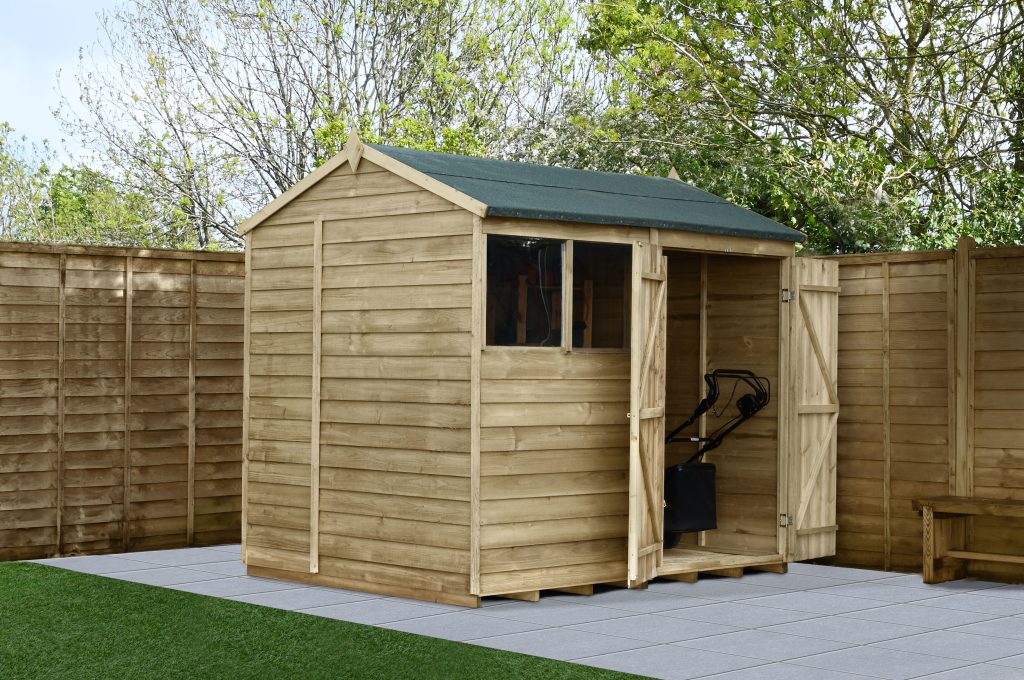
5. Where will you position your shed?
The base for your shed is an important consideration to guarantee its longevity. You will need to ensure a flat, stable and permanent base with a sturdy foundation. Base options include:
🌱Using concrete slabs with minimal gaps between them.
🌱Creating a solid concrete base to minimise sub-soil movement.
🌱Or opting for a timber shed base frame.
Also important when choosing the right spot for your shed is to select an easily accessible and tidy space where you can keep foliage and climbing plants at bay. This will not only prevent potential damage to the shed’s structure but also make any maintenance and cleaning tasks hassle-free. 4Life and Beckwood sheds will give you maintenance freedom – an annual preservative is never needed.
Other location decisions include whether you might need a power supply and if so the ease of getting that power to your shed. If solar lighting and power are preferential then weigh up the hours of strong daylight your shed will have to fuel it but also consider strong light in summer will make the shed warm.
You don’t usually need planning permission for domestic outbuildings, as long as they are used for a domestic purpose related to your house. However, please check with your local planning authority before installing any large garden buildings.
6. What layout of your shed do you need?
Hopefully, you’re feeling clearer now about the size, style and construction of your shed, as well as its location. We’re almost there, but we just have a few more tips for finding the perfect solution.
The final consideration is the configuration of the shed. Here are some questions you might like to ask yourself.
- Do you need opening windows? Think about the size and quantity of windows if you need plenty of natural daylight for a creative workshop or gardening haven.
- Do you need a single or double door? If you are storing larger equipment, would double doors be of use? Would a secondary access door be useful?
- Extra security? For extra security or simple storage, maybe you would prefer no windows at all.
- More storage? Do you need extra storage with an integral log stores or storage rooms?

Final thoughts
Other shed-style solutions for the garden include summer houses, log cabins and garden rooms. Forest Garden has a wide range of all of these garden buildings so head over and take a look if you are looking for something a little different to the traditional shed.
Choosing the best garden shed is a decision that goes beyond functionality; it’s an opportunity to enhance your outdoor living experience and make a statement. By carefully assessing your needs, considering the available space, and selecting a shed design that complements your garden’s aesthetics, you can find the ideal storage solution, workshop haven, or gardening sanctuary.
As you choose your shed, take your time, do your research, and explore the diverse options available. Whether it’s a charming Apex shed, a sleek Pent design, or a distinctive Reverse Apex, there’s a shed that will perfectly align with your needs.
So, go ahead and make your garden plans happen with the perfect shed that will bring joy and practicality to your space for years to come. Happy shed hunting!
Your garden may be small but that doesn’t mean it can’t become a beautiful outdoor space. A place to rest, to connect with nature, to grow or play. As you’ve landed here, we’re guessing you must be questioning how to improve your small garden, yard or courtyard, so read on. We have a whole guide on stylish ideas for small garden spaces, including an example of a courtyard space we transformed. We also have some clever space-saving products too. Thought you couldn’t have a garden bar or a greenhouse – you can now!
Ready to feel inspired to update your small garden?
The benefits of a small garden
With a population seeking downtime like never before, it’s no surprise that outdoor spaces, however large or small, add value to homes and property. A well-designed courtyard can be a valuable addition to a home. Why is this? Let’s look at the benefits a small outdoor space can offer.
🌱Extended living space for relaxing, dining, entertaining or playing.
🌱A source of stress relief and a calming retreat to support your wellbeing.
🌱A place to connect with nature, support wildlife and live a more sustainable lifestyle – growing your own food, herbs or flowers, even composting becomes possible.
🌱Space for kids to play and learn.
🌱A canvas for creativity and self-expression. There’s so much joy to be had by nurturing plants and creating a happy haven of colour.
🌱Smaller gardens are easier to maintain which once again supports your wellbeing.


Understanding your small garden space and your vision
If space is limited, you’re going to have to be really specific with how you use every centimetre of space.
Start with your vision for your garden. How do you intend to use the space? What’s the number one thing you will do in your garden? Prioritise this and work out from there. Is growing your priority? A space to enjoy your morning coffee and to dine in the evening with friends. Is encouraging wildlife important to you?
Another important consideration is the amount of sunlight your outdoor space gets. Is it shady, full of sun or a bit of both as this will sway your usage decisions too? Like where you position a raised bed of flowers or your seating area.
Is your space overlooked and you’ll need to create a private area away from eyesight?
Mediterranean, tropical, minimalist, cottage. Is there a style and vibe you’d love to create with your courtyard? Think about your interior living style and consider how you might transport it to the outdoors.
Designing a small garden
Less is more in a small garden but that doesn’t mean everything needs to be small. A lot of small elements can create a very cluttered feel, so you may be better off choosing bigger more dominant features and planting to balance the space – but at the same time, don’t overwhelm the space. Think simplicity.
Vertical space is hugely important in a small garden where often you have more space upwards than you do outwards. Think about growing plants on walls, training them upwards or hanging them from a structure such as trellis, our Living Screen Planter (great for rental properties as it doesn’t need to be fixed to a wall) or our Vertical slatted wall planter.

Vertical structures that can serve multiple purposes are ideal, like privacy screening that can also provide support for climbing plants. Our Slatted Archway works well for this purpose as do all our screens, and Slatted Corner Pergola. Keep scrolling down to see how we used our Slatted Arch in our courtyard transformation example.
Create key focal points within the space. Something to lead the eye and create interest. Consider a small pergola, a tree, colourful planter, sculpture, or water feature.
Clever multi-purpose usage of areas is going to be the ideal situation. A space that works for 2 different purposes. Think about storage under bench seating rather than free-standing garden furniture. Raised beds or linear planters that can also act as dividers. Our fold-down garden bar provides a brilliant entertaining space and when not in use can be folded away almost flush with the wall.
A tree is always an asset to an outdoor space, even in a small garden. It leads the eye, attracts wildlife and can look really pretty adorned with solar lights. Garden designers always champion trees in small gardens.
Mirrors and reflective surfaces are also useful in giving the illusion that the space is bigger than it really is.
Small courtyard garden transformation case study
We worked with multi-award-winning garden designer Martyn Wilson to turn an underused yard into a stunning courtyard garden space. It was an easy process with the creative use of zones and our linear planters, corner seating, trellises, and panels.
The brief was to create a stylish space with relaxing seating, alfresco dining and subtle planting. We even managed to squeeze a greenhouse in for a bit of growing space.
We also collaborated with Marshalls Slabs to turn this unused space courtyard in Worcestershire into a beautiful, multi-use area.
Want to create your own courtyard garden? Here’s some of the features we incorporated.
🌱Fold Down Garden Bar to create the perfect space for a morning coffee or evening drinks, accompanied with tall bar stools.
🌱Slatted Garden Arch to create a walkway between the entertaining space and seating area and create a vertical growing space.
🌱Linear Planters to divide the 2 zones.
🌱Victorian Tall Wall Greenhouse to support the homeowners’ interest for growing their own vegetables. We also have a smaller greenhouse available, the Georgian Tall Wall Greenhouse.
🌱Modular Garden Seating V3 was used for the seating area, incorporating upright trellis panels, 2 benches, 2 square seats/tables, and 2 square planters. We have 5 different modular garden seating sets including 2 smaller versions.
🌱1.8m x 1.8m Grey Painted Contemporary Double Slatted Fence Panels to edge the garden and create privacy.
🌱600mm Slatted Garden Trellis was positioned against the back wall to create vertical growing space.
🌱Marshalls Argent© Smooth paving 600x600mm

Final thoughts on small space gardens
When it comes to small garden spaces and courtyard gardens, every choice and every inch counts. Applying key design principles can turn even the most compact courtyard into a lush, inviting hideaway with focal points leading the eye and space maximised through the use of vertical gardening.
Whether your aim is to create a vibrant space for entertaining or a quiet corner for reflection, remember that simplicity often speaks volumes, and the right lighting can bring magic to the smallest garden at twilight.
We hope this guide and case study inspires you to see beyond the limitations of size and helps you to cultivate a space that reflects your personal aesthetic and fulfils your outdoor living dreams. Your tiny patch of outdoor space is waiting to become your garden.
Thinking of growing your own cut flowers? Transforming your garden into a mass of vibrant colour and then bringing the joy of fresh blooms into your home? From tulips to cosmos, dahlias and zinnia, there is so much satisfaction in nurturing tiny seeds to become beautiful flowers.
To help you embark on your journey of growing cut flowers from seed, we asked cut flower growing expert Sophie Van Gerwen, better known to her Instagram followers as @floraldaysintheshires, to guide us through a year of flowers. Sophie has been growing flowers from seed for over a decade having set up various school gardens and forest schools.
From her garden in Wiltshire, Sophie shares her extensive knowledge to bring you a plethora of tips, mini-tutorials and general advice, tailored to each of the seasons. It’s perfect for beginners, but there are plenty of tips for you if you’ve already been growing for a while. Here’s her guide to a Year of growing flowers.
Meet Sophie: Instagram
Whether you have a modest courtyard or balcony space or a sprawling garden, our guide is designed to ensure that you can create your very own patch of flowers, heaven for you and for the pollinators too.
Read on for a trove of tips, with each month unfolding new ideas and secrets. Let’s grow together with this year of growing cut flowers.


JANUARY & FEBURARY – Planning your cut flower garden
The early part of the year is for planning your cut flower garden. This is the time to decide which flowers you would like to grow and where you will grow them. Consider bloom time, height, colour, and how they will look together, but also think about your favourite flowers and the sort of blooms you would love to have indoors through Spring and Summer.
It can be useful to jot down notes, make lists and sketch out your plan for your garden.
Some questions to ask yourself…
🌱Which seeds will you sow?
🌱How many plants will you need?
🌱Will you plant in garden beds or pots and containers?
🌱How will your garden beds look?
🌱Do you need to prep your garden beds?
Order your seeds early to ensure you get the varieties you want.
MARCH – Seed Sowing season
March is the time to start seed sowing. Look back at the plans that you made in February, select your seeds and follow the advice on the packets.
Sophie’s favourite flower varieties that you may like to try include Larkspur, Cornflowers, Sweet Peas, Verbena and Gomphrena. Scabiosa, Cerinthe, Ammi Majus, Salvia Clary Sage, Calendula (these are hardy annuals) and later in the month, Cosmos, Zinnia, Didiscus, Rudbeckia and strawflowers (these are half hardy!)
Use a windowsill propagator and peat-free multipurpose compost with a little added vermiculite to help with drainage.
Then you can start seed sowing. Leave your seeds to propagate indoors on a sunny windowsill to germinate as your greenhouse may not be warm enough. You can move them into a greenhouse once it’s a bit warmer and the seedlings are developing. You will need to transplant your seedlings into individual pots when they have 2-3 sets of leaves upwards.
“Seed sowing is such a wonderfully mindful activity that I just love”, says Sophie.
These tiny seeds of the beginning of what could be, a year of flowers!
Watch Sophie sowing here seeds: https://www.instagram.com/reel/Cp7CLUEKbT7/?utm_source=ig_web_copy_link&igshid=MzRlODBiNWFlZA==
Planning to grow sweet peas?
Sweet peas are totally worth growing for the whimsical country garden vibe they create.
Tips for sowing the sweet pea seeds:
🌱 Sow your sweet pea seeds into deep pots or root trainers as any pea plant likes to grow long roots.
🌱Put them on a warm sunny windowsill and they will germinate quite quickly.
🌱Pinch out the growing tips when the seedling has at least 3 pairs of true leaves. This will encourage the plant to branch out giving you more flowers.
🌱Sweet peas need moist and well-drained soil and need a sunny spot.
Once planted outside later in Spring, Sophie grows her sweet peas up obelisks. You can also use a wigwam of canes or sticks, jute netting, a timber screen or trellis.

APRIL – Dahlia potting
Arriving in April, it’s time think about dahlias, which will flower through August and late into Autumn when the first frosts arrive. There are so many styles and colours of dahlia to choose from including single dahlia’s, pompons, cactus and balls. Gardeners World explains. https://www.gardenersworld.com/plants/dahlia-types-explained/
Potting up your dahlia tubers in the Spring means they get a head start with their growth before you plant them in your garden. When your tubers arrive, pot them up using a multipurpose peat-free compost mixed with a little vermiculite.
New dahlia growth is loved by slugs and snails so starting them off indoors or in your greenhouse will protect them in those early stages.
Water them in but then don’t water them again until you see signs of new growth as overwatering can rot the tuber.
Think about how you going to protect your dahlias when you plant them outside after the last frosts. Sophie uses copper rings which help prevent snail damage and Nematodes for slugs.
Dahlias will need a sunny spot and support when you plant them outside so preparing these things in advance will help you grow these gorgeous flowers for the summer and autumn.
Which way up does a dahlia tuber go? Watch Sophie plant her dahlia tubers: https://www.instagram.com/reel/Cqe_eI2KsbM/?utm_source=ig_web_copy_link&igshid=MzRlODBiNWFlZA==
APRIL – Cosmos sowing
Cosmos is a fabulous seed for beginners to grow. A half-hardy annual cut flower that is perfect to sow in April and May.
They are a true “cut and come again” flower as the more you cut from them, the more flowers they produce.
They come in some fabulous colours, work well in the cutting patch or garden and can even be grown in pots or planters.
Sow the seeds in April in peat-free compost straight into 9cm pots and pop them onto a sunny windowsill. They can be planted outdoors into containers and garden beds after the frosts and you will have flowers all summer and into Autumn.
Sophie grew some yellow varieties last year – Xanthos and Kiiro but here are some others you may like to try:
🌱 Pink cupcakes
🌱 Double click Rose Bon Bon
🌱 Purity
🌱 Apricot Lemonade (great for pots)
🌱 Pink popsocks (great for pots)
END OF APRIL – Pinching out dahlias
Towards the end of April, it’s time to pinch out the growing stems of dahlias to encourage them to bush out.
This, in turn, produces more flowers. We only do this for any potted dahlias that are not sending out more than one stem. If they already have multiple stems, then you won’t need to do this step.
Count from the bottom, 2 or 3 sets of leaves and cut just above the leaf node. If any leaves are damaged cut slightly higher.
Give your potted dahlias a water at this stage and even a little diluted seaweed feed to help give them a boost.
Allow them to grow on in your greenhouse or warm home until the risk of frosts has passed. Then you can begin to harden them off by increasing the time they spend outside each day until you can plant them outside. This hardening off process may take about a week.
Remember you’ll need to think about how you will prevent them being eaten by slugs and snails so invest in some nematodes and copper rings.
How to pinch out your dahlias: https://www.instagram.com/reel/CrkaRd_qjye/?utm_source=ig_web_copy_link&igshid=MzRlODBiNWFlZA==
MAY – Direct sowing
Early May is a good time to direct sow flower seeds as the soil is warming up. There are lots of seeds that can be direct sown, although some do better than others. Seeds that could work with this method include Salvia clary sage, corncockle, cornflowers, calendula, dill, and nigella.
Mix your seed with some multipurpose peat-free compost and follow Sophie’s guidance. https://www.instagram.com/reel/Cr2bwHzK7Gw/?utm_source=ig_web_copy_link&igshid=MzRlODBiNWFlZA==
Loosen the soil where you are going to grow them, then sprinkle with the mix of seed and compost. Push the soil down a little to make sure the seeds have good contact with the ground, water and then allow nature to do its work.
You could even direct sow zinnias and cosmos in this way. Make sure they are well watered and as the seedlings emerge, try to protect them from slugs and snails by using beer traps or wool pellets.

MAY – Planting flowers for pollinators
Did you know one out of every three mouthfuls of our food depends on pollinators such as bees? (source WWF) https://www.wwf.org.uk/updates/our-tips-how-bee-friendly. That’s how important bees are. Meaning planting our gardens to attract and support bees and other pollinators is essential.
Sophie’s top flowers for pollinators are Borage, Lavender, Single dahlias, Foxgloves, Sunflowers, Cornflower, Rosemary and Cosmos.
Will you add some of these to your cut flower garden to encourage the bees?
JUNE – Plant out your dahlias
It’s time to plant out your dahlias. Harden them off first by gradually getting them used to being outside during the day over a week. Pop them outside each morning and then put them back into the greenhouse overnight.
When you are ready to plant them, prepare your soil by removing any weeds and get planting. Sophie suggests adding a handful of bone meal to the soil to add phosphorus which helps with healthy root development. Water them in as they will need a drink. Then water them once or twice a week depending on the weather. Sophie also feeds her dahlias every 2 weeks once they start flowering.
Your dahlias will need support as they can grow up to 1.5m tall. You can use a simple system of a roll of stock fencing supported by a bamboo cane or could easily use bamboo canes with string or jute netting. The supports look huge to start with but you’ll be amazed how quickly your dahlias will grow up to and beyond the support.
You will need to protect your newly planted dahlias from slugs and snails. You could treat your beds with nematodes which really helps or use beer traps, copper rings or wool pellets.
Watch Sophie plant out her dahlias: https://www.instagram.com/reel/CtBJcdTKsVS/?utm_source=ig_web_copy_link&igshid=MzRlODBiNWFlZA==
JULY – Cut your flowers
July is the month you’ve been working towards and the month to start cutting your flowers to enjoy indoors.
Some tips for you for cutting flowers
1. Cut your flowers using a sharp pair of snips as not to snag the stems.
2. Cut at the beginning or end of the day rather than in the midday sun.
3. Cut with a slight angle to enable any water to run off the old stem rather than into it as this can cause disease.
4. Cut as deep into the flower stem as you like and cut above a pair of leaves if possible.
5. Put your flowers into a bucket of cool water up to their necks and leave for at least 24 hours in a cool place.
6. Take off any leaves that will sit below the water line of your vase to stop any bacteria forming in the water. This will make the blooms last longer in your vase.
Watch Sophie cutting her flowers: It’s time to start cutting your flowers if you haven’t done this already. This is why we have grown them and as it’s #britishflowersweek… | Instagram
JULY – Roses in cut flower gardens
A note about roses, one of the most well-known of all cut flowers.
To keep roses looking fresh and to encourage a second flush, it’s best to deadhead them to stop them from developing rose hips.
To do this, cut off any dead flowers and this will encourage your rose to make new flowers. This is obviously depending on the rose you have as some only flower once during the year.
These roses are Olivia Rose and A Shropshire Lad from David Austin Roses https://www.davidaustinroses.co.uk/ and they both will flower again once deadheaded.
Include pics
AUGUST – Time to enjoy your cut flower garden
August is a time to really enjoy the garden and all the flowers you’ve grown. Continue to cut and deadhead which encourages plants to keep producing more flowers before they go to seed.
Feeding your plants throughout August will encourage more growth and flowers into September and beyond.
By August Sophie also has a greenhouse full of biennial seedlings to nurture ready to plant out in September. These include Papaver, Rudbeckia, Angelica Archangelica and foxgloves.
Sophie’s garden in August: https://www.instagram.com/reel/Cvg2OiSKu98/?utm_source=ig_web_copy_link&igshid=MzRlODBiNWFlZA==
LATE AUGUST & SEPTEMBER – Seed collecting
Late August and September are perfect for collecting seeds from your favourite cut flowers and it’s a great way to save a little money in the process. Saved seed is fresher and should germinate quicker too.
Tips for gathering seeds
You’ll need a pair of scissors, envelopes and a pen.
1. Allow your favourite flowers to go over and develop seed pods.
2. Choose a sunny afternoon to harvest the seed pods and flowers. You want to collect seeds before the pods have burst open.
3. Cut the seed pods or dried flower heads, being careful that the seeds don’t spill all over the place! Catching the seeds into an envelope works well.
4. Put them in a place to dry. This could be on a sunny windowsill or outside if it’s not raining or windy!
5. Once dry, store in a paper envelope naming the seeds straight away. Otherwise you won’t remember which seeds are which.
Seeds Sophie recommends collecting include Poppies, Nigella, Cress, Scabious, Briza, Orach, Dill, Sweet peas, Ammi, Cerinthe, Larkspur, Honesty and Tagetes.
SEPTEMBER – Enjoying dahlias as cut flowers
For September we return to dahlias, the queens of colour in a late Summer and early Autumn garden.
As your dahlias start to get into their stride after a tricky start, you may wonder how to get a decent stem length on your blooms to enable you to use them in a vase.
1. Cut deep into your plant! Dahlias are truly “cut and come again” plants and will reward you with more blooms when they are cut. Don’t worry about cutting off side stems in the process as your plant will grow new ones!
2. Disbud your dahlias. Disbudding is the process of removing the side buds on a main stem to allow the plant to put all its energy in the main flower. This means you get larger blooms on the main stem.
3. Feed your dahlias! After a tricky start with all the rain we’ve had, your dahlias may have grown tall but will now need more potassium and phosphorus to grow those beautiful blooms we all love! I feed mine once a week during the flowering season.
Watch Sophie cutting her dahlias https://www.instagram.com/reel/Cw3BPOmrHYk/?utm_source=ig_web_copy_link&igshid=MzRlODBiNWFlZA==
OCTOBER – Tidying up and planning again
In Autumn, jobs for the cut flower garden are more limited, but as light levels drop, it’s important for your plants and seedlings to get as much light as they can during the darker months. And so greenhouses need to be cleaned inside and out. If you have a wooden greenhouse, it may also need oiling to protect it over the winter months.
Hardy annual seedlings and salvia cuttings can be potted up to get them ready for overwintering in the greenhouse.
You might also like to move your succulents under glass, as well as planting up some violas and pansies to bring joy throughout the winter.
Autumn is also a good time to plan what to grow for the following year whilst your success of
Sophie’s Autimn garden: https://www.instagram.com/reel/CyFmtinK_M1/?utm_source=ig_web_copy_link&igshid=MzRlODBiNWFlZA==
OCTOBER – Saving your dahlia tubers for next year
It’s time to think about whether you will lift, dry and store your dahlia tubers or cover them in a layer of mulch, for the winter!
Sophie does a little of both in her Wiltshire garden. The weather is generally wet with some frosts. The dahlia tubers in the garden borders are covered with old compost. This is called mulching and it gives the tubers a layer of protection against the cold weather. Sophie has done this successfully with most of her tubers for the past 4 years, only loosing a few to rot due to it being very wet.
Sophie then lifts her dahlia tubers in the cutting garden. In 2022 she did this too late (during the second week of November). “When we had a very cold spell in early December, the tubers hadn’t had time to properly dry and therefore they all rotted.” So in 2023 Sophie began to lift her dahlias at the end of October to protect them for Winter.
To lift your dahlias, choose a dry day and shake off as much soil as you can. Then turn them upside down and store them in a frost free place to drain and dry. This can be in a greenhouse, shed or kitchen. Then carefully pack them into crates with newspaper, or straw and store them in a frost free garage.
How to care for your dahlia tubers: https://www.instagram.com/p/CyXrj2JqjS_/?utm_source=ig_web_copy_link&igshid=MzRlODBiNWFlZA==
NOVEMBER
November is the time to start thinking about next year’s garden and making sure you have a colour filled Spring garden.
Tulips planted in pots and containers look stunning and can be useful in smaller gardens or on a patio. They can be grouped together with other pots of tulips or other spring bulbs to make a beautiful spring display. November (or later) is a good time to plant tulips as any earlier they can be susceptible to tulip fire. https://www.rhs.org.uk/disease/tulip-fire
How to plant your tulips
🌱Using a mixture of peat-free multi-purpose compost and horticultural grit for drainage, fill your pots to about 2/3 of the way from the bottom.
🌱Add your tulip bulbs with the pointy end facing upwards. Bulbs can be planted quite close together in pots but they shouldn’t be touching each other.
🌱Cover the bulbs with more compost and top with a layer of grit. This helps to stop soil escaping in heavy rain.
🌱Place them in a sheltered spot outside to stop them becoming waterlogged as this can make the bulbs rot. They do need a frost though and this is encouraged so don’t put them in a greenhouse or shed. Position them in the spring to enjoy their blooms!
🌱If you have lots of squirrels in your area, top with chicken wire, holly leaves or every chilli powder to deter them.
How to plant tulips in pots; https://www.instagram.com/reel/CzO8PkyLGma/?utm_source=ig_web_copy_link&igshid=MzRlODBiNWFlZA==
Growing cut flowers is a thoroughly rewarding way to spend time, sowing seeds, nurturing seedlings, potting on, planting out and reaping the rewards later in the year. We hope you’ve picked up some tips from our year of growing your own flowers and that you have as much fun growing as we did.
As the cooler damper months approach, it’s time to prepare your garden and Winter-proof your garden shed. We’ve been designing and manufacturing sheds for over 50 years and whilst we have now hit upon a design that minimises the need for annual maintenance, you will most likely have a shed in your garden that does need to be taken care of. We’ve picked up plenty of shed care tips along our journey to share with you.


Follow these steps to winter-proof your garden shed:
1. Clear the gutters and roof: The first step to winter-proof your garden shed is to clear out dead leaves and debris from the gutters and from the roof. When leaf debris accumulates, it will also collect and pool water which will cause damp spots. At best, the damp spots will create higher moisture levels inside the shed damaging the garden tools and equipment you have stored. At worst, you’ll also risk rotting the timber structure. Keep the gutters and roof free of debris to prevent dampness from occurring.
2. Cut back foliage: Similarly, you will need to make sure you cut back any overgrown foliage and branches so they are not resting on your timber. Any foliage touching your shed will also be a risk for the creation of damp spots, whilst larger vegetation such as branches risk being moved and broken in high winds or with heavy snow and damaging the structure of the shed.
3. Treat the wood: If you have a dip-treated shed, it is important to treat the wood. The application of an annual wood preservative paint will protect the timber from moisture, insects and funghi. We also recommend the annual application of a wax or oil-based weatherproofing finish.
A clear dry day is best for treating your shed so that the oil has time to soak in and penetrate the timber, giving it long-lasting protection. Apply it on a rainy day and you’ll risk the treatment being washed off before it has had a chance to work its magic.
4. Inspect the roof: Next you’ll need to check the integrity of your felt roof, looking for cracks and damage. Check for cracks and damage. Replace the old or broken felt to prevent leaks and ensure the interior of your shed and the items you have stored remain dry and safe all Winter.
5. Consider what you store: You’d think that a shed is a shed and you can store whatever you wish in your shed over winter. The truth is there are many different ways to design and build a shed, some more weatherproof than others. Some shed designs will let more air and moisture in and will also have shorter lifespans. So carefully consider what you store in your shed, like valuable garden tools that could attract rust over the damper months.
Have you winter-proofed your shed yet?
Introducing the new maintenance-free choice for sheds

New in 2023, we’ve launched our brand-new range of weather-beating sheds – the Beckwood sheds. Designed to be completely maintenance-free (annual preservative treatment is never needed), these study sheds are the perfect option for busy lives. They are made with pressure-treated timber providing a 25-year anti-rot guarantee, the longest guarantee in the market. Check out the Beckwood range today.
If you’re fortunate enough to own a wooden greenhouse, you’ll know the joy of having this idyllic growing zone nestled in your garden or on your patio. Timber greenhouses really do stand head and shoulders above their metal and plastic greenhouse counterparts. They are so much more than a functional space to nurture seeds and vegetables: they’re also an attractive garden feature to enjoy throughout the seasons.


With over 50 years of expertise in designing and manufacturing timber garden products, we’re here to guide you in choosing the perfect paint colour to enhance the beauty of your greenhouse.
Why choose a timber greenhouse?
Opting for a natural wood greenhouse offers a multitude of benefits, chief among them is that the materials effortlessly blend with the natural landscape of your garden.
Our research study showed how much gardeners are thinking about the environment and really embracing natural materials including wood in their gardens as a sign that they are doing the right thing by buying more sustainably. Wood has firmly established itself as the preferred choice for the eco-conscious gardener.
Many quality wooden garden items including our range of timber greenhouses, are pressure-treated, ours come with a 15-year anti-rot guarantee. With simple maintenance, your timber greenhouse will endure a long lifetime.
After that, as a natural resource, the timber will feed the ground from which it came (unlike plastic) leaving no particles that could be potentially harmful or have a lasting impact on the environment.
By choosing timber, you’re not only enhancing your garden but also contributing to a more sustainable and eco-friendly future.
To paint or not to paint. Enhancing your wooden greenhouse
So should you paint your wooden greenhouse or leave it as it’s natural timber?
The choice is yours. At Forest Garden, we provide you with the freedom to choose.
It’s worth noting that all our timber greenhouses come pressure-treated, complete with a robust minimum 15-year anti-rot guarantee. This treatment involves impregnating the wood with preservatives, safeguarding it against the perils of fungal decay and pesky insect invasions.
Opting to maintain the natural wood finish is a fabulous choice, ensuring your greenhouse will become part of the natural beauty of your outdoor space. Over time, the wood’s colour will gracefully evolve into a charming silvery-brown hue, enhancing its rustic appeal.
Stains and water repellent can be applied if you would like to add a touch of personal style to your greenhouse, provided you follow the manufacturer’s instructions.
Consider selecting a natural wooden stain that not only retains the timber’s original colour but also ensures the natural wood colour doesn’t fade over time. We would suggest a UV Clear Wood Paint such as those from Thorndown Paint Wood Paint range.

What colour to paint your greenhouse
Painting your greenhouse will give it added protection from the elements and turn it into a real feature within your garden.
The world of paint offers endless possibilities, allowing you to tailor the look of your greenhouse to your preferences. Paint can create quite a transformation, so think about the look you are going for. Are you aiming for a big colour pop or statement feature or something softer that harmonises with the natural tones of your garden?
Thorndown Paints has a wide range of wood paint spanning the spectrum from lush greens to muted blues and creamy neutrals – practically every shade of the rainbow.
We’re always thrilled to see the creative flair of our customers when it comes to painting their greenhouses. Greens and creams are definitely the most popular colours, but we’ve also seen blues and pinks too.
If you’re in search of inspiration, take a look at the spectrum of colours we’re showcasing in this blog.
How to paint your greenhouse
To achieve the best results when painting your greenhouse, consider the following tips:
- Pre-assembly painting: As our greenhouses are delivered flat packed ready for self-assembly, it’s ideal to paint before you construct. That way you can easily get into any tricky corners. A word or warning, please double check the components list to ensure all of the parts have been included.
- Paint before you remove the protective film. Each glass/acrylic glazing window panel is covered in a protective film to ensure the glass is kept clean and unscathed in transport. Paint before you remove the film and you will have the cleanest lines for your end result.
Best greenhouse paint?
You will need to use outdoor wood paint for your wood greenhouse. We have worked with and used Throrndown Paints many times so can recommend them as a starting point. Customers have also previously used Cuprionol and Rustoleum paints and reported great results.
So which colour paint will you choose?
Ultimately, the decision of whether to paint or leave your timber greenhouse in its natural state is a deeply personal one, a choice that mirrors your unique gardening vision and style.
As you ponder the colours and finishes that will adorn your wooden growing haven, don’t forget to take a peek at our stunning range of timber greenhouses.


What you keep in your shed says a lot about where you live, according to new data from Forest Garden, the UK’s leading manufacturer and distributor of wooden garden products.
To celebrate the launch of their brand new Beckwood range of sheds, Forest Garden surveyed 2,000 shed-owners across the UK to find out just exactly what is going on in those special garden buildings.
And it turns out shed-owners in London are most adventurous with what they use their sheds for – closely followed by Northern Ireland, the North West and the West Midlands.
Among those in the capital who admitted to changing their shed’s primary function, 28% turned it into a ‘Chillout Space’, while 18% used theirs to create a ‘Dining Area’. Other uses included ‘Cinema’ (15%) and ‘Art Studio’ (10%).
Meanwhile shed-owners in the east of England are least likely to use their shed for anything other than storing garden tools (81%).
And Northern Ireland not only has more sheds per person than anywhere else – but one of them will probably have a freezer in it.
Jenny Davis, Forest Garden’s Head of Marketing, said: “Sheds are no longer simply a dumping ground for garden furniture and equipment. They are versatile and dependable and ideal for those who want to store more than just a spade.
“Our Beckwood range of sheds have been designed with this in mind.”
Nationally more people would rather turn their shed into a bar (8%) than into a home gym (6%), and while the 25 to 34-year-old age group are the most likely to make these alterations, the 55 to 64-year-olds are close runners-up in converting theirs into a cinema.
Twice as many women than men have converted their garden sheds into a music studio, while 35 to 44-year-olds are most likely to keep bikes and other sporting equipment in their sheds. Similarly, 25 to 34-year-olds keep mountaineering and hiking gear in theirs.
39% of those over 65 questioned said they go into their sheds once or more every single day. And 20% of 55 to 64-year-olds say their shed is mainly full of ‘broken stuff”.
118 people in the survey admitted to having spent the night in their shed.
The results come as Forest Garden, the UK’s leading manufacturer and distributor of wooden garden products, launch their Beckwood range of sheds, designed to accommodate far more than garden equipment.
The NEW range of Beckwood Shiplap Sheds are made with weather beating, interlocking cladding giving a watertight seal that will stand up to everything the great British weather can throw at them.
What’s more, they come with a 25-year anti-rot guarantee the longest guarantee in the market. They are fully modular and are completely maintenance free, annual preservative treatment is NEVER needed. Most other sheds require immediate treatment once built, then yearly treatment thereafter.
Is your patio looking a little sad, uninspired or neglected? If you’d like some ideas for sprucing it up and making it an attractive and pleasant place to be, then read on… Here’s five easy ideas to spruce up a patio.
1. Zone your patio from the rest of the garden
You’ll find that dividing the patio from the rest of the garden can make it appear like a separate garden room or intimate space. Having a distinct edge to the area creates a clear sense of space and focus.
At Forest Garden, we have a Linear Long Planter that might just do the trick. Boasting strong horizontal lines and a contemporary look, you can plant flowers for colour, or leafy plants and shrubs for texture and structure, creating a striking display. This style of planter works well as a boundary between the patio and the lawn or driveway.
Our Living Screen Planter can be used in a similar way – either to create a border between the patio and the rest of the garden, or to disguise a house wall or shed. If your patio is close to the kitchen, you could always use our planters as a place to grow herbs to add to your cooking. Why not use one of our hard-wearing and eye-catching planters to help you define your patio area?


2. Add soft furnishings to your patio seating area
Soft furnishings is an easy idea to spruce up your patio. You may want to give your patio a glamorous makeover by purchasing an outdoor rug. There’s a new trend in outdoor rugs made from recycled plastic and they’re absolutely beautiful! They come in all kinds of colours and designs.
And adding bright cushions and throws to your outdoor seats can add a hint of luxury as well as comfort.
Our Harvington 5ft Bench or our Harvington Love Seat look gorgeous with added cushions and accessories, helping you to create that perfect spot for relaxation. You may even want to include some bright flower pots or planters, some fairy lights and a coffee table – then your patio will make you feel like you’re on holiday all the time!


3. Upgrade your garden furniture
Choosing the right style of garden furniture to fit the space is crucial. You don’t want your patio to feel overcrowded and cluttered, so choose the items carefully. Also, decide if you want to use the patio for outdoor dining, with a table and chairs, or simply for relaxing with a coffee table and a lounger.
Forest Garden’s sleeper furniture works well with our corner and linear planters. Our Sleeper Benches are both strong and attractive – and they provide great places to have a coffee and read a book.
Alternatively, our fantastic Modular Furniture range is ideal for designing a private and cosy garden room. Each set comes with a selection of upright trellis panels, a bench, a square planter and a square seat. You can easily create a personalised, secluded and peaceful space with this versatile furniture.


4. Add a pergola to your patio
4. Adding a pergola can really make it stand out and is an good, easy idea to spruce up your patio. This instantly turns your outdoor space into a beautiful feature.
Depending on the size and shape of your patio, you may want to purchase our delectable Dining Pergola with its modern, striking lines. This certainly will create a talking point! The laddered side and roof panels not only make the pergola appealing, they’re perfect for growing sweet-scented climbing plants and creating shade.
If you have less space, our Slatted Corner Pergola works in a similar way to our corner planter, in that it delineates the edge of the patio, but it also allows you to train climbing plants here and create a beguiling, shady space. You may even want to add hanging plant pots to your pergola.
Our slightly more robust design of Radial Pergola works in the same way, creating intimate and attractive outdoor rooms.


5. Add a garden bar to your patio
5. If you like to entertain in your garden, a Fold Down Wall Garden Bar is the ideal solution – especially if your patio is restricted in terms of space.
No matter how small your patio is, this fold-down bar is an enjoyable idea and the perfect location for entertaining. It even fits on a balcony! This wall-mounted bar allows you to store bottles and glasses on internal shelves and it has a fold-away serving table. You’ll be amazed at its space-saving design. If you have more room add either an Apex 6×4 Garden Bar or a Pent 6×3 Garden Bar.
Whatever steps you decide to take to improve and smarten up your patio, don’t be afraid to add your own personality to the design. We hope these easy ideas to spruce up a patio help make it as comfortable, usable and attractive as you can – a place where you’ll long to spend time both on your own and with friends and family. Enjoy the outdoors in comfort!


Even in a rainy country like the UK, it’s sensible to consider adding some shady patches to your garden for when we get the elusive sun. Although most of us enjoy being out in the sun – and sunbathing can boost our Vitamin D levels – it’s vital that we don’t burn. Here are some simple ways to add shade into your garden.
So, creating shade where we can cool off and unwind is always a good idea. Shady places are perfect for relaxing in, for reading a book, resting, enjoying a meal, or working outdoors. So, how can you add some shade to your garden?
Garden shading ideas the natural way
Of course, if your garden is big enough, planting some trees is a wonderful, long-term solution. However, trees will take many years to grow, and you won’t benefit from their shade for quite some time, so you may have to think about an instant yet stylish solution, such as:
Pergolas create fabulous garden shade
A pergola might just be the answer you’re searching for, and at Forest Garden, we have many to choose from.
- Our practical and versatile 2m square Modular Pergola comes with a roof, which immediately provides shade and shelter so you can enjoy your outdoor space fully. You may even want to select some side panels for extra protection and privacy.
- If you have a larger garden or patio, our Dining Pergola is really eye-catching. This beautiful and elegant design allows you to create a room outside – the perfect space for outdoor dinner parties. The laddered side and roof panels make the pergola attractive and perfect for training climbing plants and creating shade.
- Our robust Ultima Pergola comes in two different sizes and makes a striking addition to your garden. With plenty of head height, you could add some hanging plant pots or creepers to make a stunning and sweet-scented display. The Ultima Pergola is available with and without a canopy.

Choose a pergola with a canopy or create some dappled shade of your own with shrewd planting. A pergola is a great way to transform a garden or patio.
Relax in a shady spot beneath your very own Arbour
There’s nothing more relaxing and peaceful than having a pretty arbour in your outdoor space. A garden arbour can be an intimate and cosy place where you’ll want to read a book, enjoy the scent of summer flowers, or enjoy a drink with a friend.

- Our Lyon Arbour is made with an attractive trellis on the sides and back, and a pleasing roof. Again, this design is perfect for growing climbing plants such as jasmine, rose and clematis.
- Our modern and sleek Firenze Corner Arbour is larger, but designed to fit into a quiet corner in your patio or garden. Combining slats and benches, this attractive arbour is both versatile and comfortable.
- Alternatively, if you’d like to make a real statement in your garden, our solid timber Cadiz Arbour might be what you’re after. The side panels, made of trellis, give the arbour an airy and spacious feel. This is a lovely place to rest in the shade.
Create instant shade with a garden Gazebo
At Forest Garden, we’re proud of the beautiful gazebos we have to offer. You’ll enjoy being able to bring the indoors outside – and in style!
Offering lots of protection from the sun and rain, our Premium Hexagonal Garden Gazebo comes with a choice of roofs – from thatched, to cedar or timber. And coming in two sizes, there’s something for everyone’s tastes. Arrange some outdoor sofas, cushions, rugs and plant pots inside, and you’ll have created the ideal place to entertain and relax.
Our larger Premium Oval Wooden Gazebo is a real signature piece. This breathtaking gazebo is perfect for larger gardens or work venues. It can be used as a wonderful outdoor office, a place to entertain, or somewhere tranquil to put your feet up after a long day. You may even want to do your yoga or Pilates here on a hot or rainy day!
Solutions for seeking shade
The great thing about all of our garden structures is that they add height and eye-catching design to your garden, creating an instant focal point. They’re the perfect place to grow some climbing plants and create an intimate atmosphere in your outdoor space that will last for years to come.
Who would have thought that shade could be so beautiful?
Have you noticed that growing your own flowers for cutting and arranging is becoming ever more popular? It’s an ever-increasing trend. And that might just be a good thing for all of us. Read on to find out why…


Growing cut flowers brings joy
Everyone loves to have fresh blooms on display in their homes – they’re so vibrant and uplifting. There’s nothing more special than using your own flowers to mark significant events, from Valentine’s Day and Mother’s Day to weddings and funerals. Cut flowers are symbolic and play a big part in our lives.
But the environmental impact of the flower industry is devastating.
Local home-grown flowers are best
Defra (Department for Environment, Food and Rural Affairs) tells us that only 14% of the blooms sold in the UK are actually grown here. 86% of our flowers come from the Netherlands or from warmer countries like Kenya, Ethiopia and Ecuador.
Imported flowers are flown hundreds, if not thousands, of miles in refrigerated planes. In Europe, most imported plants originate from East Africa. That’s a long way to travel!
Grow your own cut flowers the sustainable way
Perhaps this is why more and more people are growing their flowers sustainably in their own gardens, either for their personal enjoyment or to sell locally.
The UK’s love for decorating homes with flowers
There’s no getting over it, cut flowers are loved in the UK. According to The Guardian, 50% of British households purchased cut flowers in 2021. That’s a lot of households! (In 2021, there were 24.8 million households in England and Wales alone.)
It’s easy to see why people are changing their ways and growing their own flowers. Not only is the carbon footprint of cut flowers being reduced, but the local environment is being enhanced for our much-needed pollinators.
Flowers for pollinators
The UK Government’s Bees’ Needs campaign explains that there are five things we can all do to help pollinators in our gardens:So, growing your own cut flowers organically, without the use of pesticides, is a fantastic thing to do for bees, butterflies, moths, wasps, flies and beetles – our crucial pollinators – which have been decimated in recent years due to loss of habitat, climate change, disease, and the use of pesticides.

1. Plant more flowers, shrubs and trees.
2. Allow areas of your land to grow wild.
3. Don’t mow the lawn too often.
4. Leave insect nests and hibernation spots alone.
5. Think very carefully about the use of pesticides – do you really need them?
Local flower growers to the rescue
Lately, in the UK, many small businesses have been established to grow and sell their own cut flowers from nearby land or from their own gardens. You can look up these businesses on the ‘Flowers from the Farm’ website: https://www.flowersfromthefarm.co.uk/
‘Flowers from the Farm’ is a non-profit organisation. It was established in 2011 and it has doubled its membership in recent years. Many of their growers use peat-free, organic conditions in which to grow their flowers, and they use paper wrapping instead of plastic. The businesses listed on the website supply flowers for special occasions or sell bouquets in nearby shops. And the variety of flowers can be staggering and, delightfully, the selection changes according to the season – as it should do.
Plan your own cut flower garden
If you’d like to start growing your own cut flowers, Country Living explains which are the best flowers to grow according to the season, from hyacinths in March, to pussy willow and tulips in April, to hydrangeas and jasmine in June. You can find out more by reading this interesting and highly useful article: https://www.countryliving.com/uk/homes-interiors/gardens/a26926413/seasonal-british-cut-flowers/
You can also follow the monthly tips we share from our cut flower expert Sophie @floraldaysintheshires over on Instagram.
What do you need to make a flower garden?
If you want to start experimenting with some blooms of your own, you might want to consider purchasing some Forest Garden Raised Beds. By using raised beds, you can introduce a different type of good-quality soil into your garden and you can improve drainage for your flowers. As the beds are raised, they’re also easier to keep weed-free. Forest Garden has a variety of styles to offer, and some of our raised beds make attractive features in their own right.
If you don’t have much space in your garden, then some of our planters might suit you better. From our Accessible Gardening Planters, which wheelchair users and the elderly can reach easily, to our beautiful Planter Sets, you will be able to create beautiful displays of flowers which are easy to access and pick.


Cut flowers make beautiful gifts or they can adorn your home with radiant beauty and natural fragrances. Why not go “blooming” crazy – for your own sake and for the planet’s?
Can gardening really reduce stress, reduce depression, improve self esteem and have a positive impact on our mood? Are there health benefits of gardening beyond the obvious physical exercise gained from digging and pottering amongst this natural environment?
It was Hippocrates, traditionally referred to as the “father of medicine”, who said: “Nature itself is the best physician.”
At Forest Garden, we think he was absolutely right, though nature isn’t just wonderful for our physical health, it’s great for our mental wellbeing too.
It’s Mental Health Awareness Week from 15th to 21st May, so let’s spend a little time considering why nature and gardening are just so good for us.


1. Gardening helps keep depression at bay
Getting your hands in the soil is known to keep depression at bay.
This has been proven by research. Making contact with the earth, and a specific bacteria in the soil called Mycobacterium vaccae, actually triggers the release of serotonin and dopamine in the body, in turn boosting our immunity and raising our spirits.
Serotonin, of course, is a feel-good chemical that fights depression.
And it’s been shown that dopamine is released when we harvest our own food. Researchers believe this chemical reaction in the body could go back 200,000 years to when our hunter-gatherer ancestors felt elated at finding food sources!
So sometimes, it seems, we need to take off our gardening gloves and have direct contact with the soil to boost our mood.
2. Gardening is powerfully rewarding
There’s nothing better than feeling the power of nature around us. The joy of watching seedlings grow is nothing short of miraculous.
But we’re quite like plants ourselves! We too need Vitamin D from sunlight to keep well – in fact, it’s essential for many bodily functions. Studies have shown that being outside in the sunlight and having enough Vitamin D in our bodies can reduce our risk of certain cancers, diabetes and even dementia. It also helps us sleep better.
We’re not advocating getting sunburnt, but the healing power of a little sunshine every day goes a long way for our bodies and minds.
3. Gardening helps improve sleep and mood
A strong link exists between low mood and insomnia. If we can’t sleep well, then our brains just don’t function properly. But an afternoon’s gardening can be quite strenuous and can promote a good night’s sleep. Raking, digging, chopping and mowing are all superb forms of exercise that will tire out our muscles, relax our brains and help us to sleep at night. Why not give it a try!
4. Gardening stimulates our senses
Being in the garden is a wonderful way to stimulate our senses – all of them!
The beauty of flowers and trees fills our eyes; we’re often surrounded by buzzing bees and the sound of delightful birdsong; we can smell the beautiful fragrances of fruits, vegetables and flowers; we can touch the many different textures of the plants around us; and we can taste the delicious and natural foods we grow.
When our senses are stimulated in the relaxed setting of our gardens or allotments, our minds start to slow down and feel calm.
When we take note of nature around us, it’s an exercise in mindfulness, which is good for the soul.

5. Barefoot walking regulates stress
Many studies have been carried out into the advantages of walking barefoot in the garden.
Make sure to avoid any sharp objects so we don’t injure ourselves! But walking barefoot has actually been linked to the development of the brain and nervous system, proving that it’s great for young children to run around and explore barefoot in the garden.
The thick skin on feet is designed to keep pathogens out, so we shouldn’t worry too much about germs. Research has also shown that walking barefoot can regulate stress responses and boost our immunity.
What a beautiful way to reduce stress. Letting the grass touch your skin doesn’t just feel good; it really is good for our physical and mental health.
6. A garden is a place to switch off
Designing a seating area for quiet time in the garden is always a lovely idea.
Having a little retreat away from the busy world where our minds can switch off is so soothing.
We may want to read a book, paint a picture or simply just “be” for a while. We don’t take enough time out from our busy schedules to rest and become mindful, and to enjoy what’s around us.
Mindfulness is about being aware in the present moment, while calmly acknowledging our thoughts and feelings in an accepting way. It’s highly therapeutic. So, during the warmer months, having a pleasant spot in the garden where you can sit and be mindful is beneficial to our wellbeing.
7. Gardening improves self esteem
According to ‘Healthline’, studies in the United States have shown that gardening offers improvements in both self-esteem and mood.
Many people have found that their anxiety levels drop, they feel less depressed and their state of mind improves when they’re gardening – and these effects can be long-lasting too. It seems we were meant to be outdoors and growing food and other plants. It takes us back to our roots (if you’ll pardon the pun!).

8. Gardens are social spaces
Gardens can also be superb places for social interaction. Whether you enjoy going to a school, allotment or community gardens, or you simply like to ask friends round to spend time in your own garden, socialising outdoors can be so refreshing.
Just spending time talking and laughing with our friends can lower our stress levels and soothe our minds. After all, we all know the old adage that ‘a problem shared is a problem halved’ – and it really is true.
We need to make time to connect with other people and in green space too. And if you like to work in community gardens, you can also learn new gardening skills and tips while making friends.
9. Eating home grown food is good for our health and wellbeing
Of course, growing your own organic fruit and veg will boost your physical and mental health.
We can’t separate our mental wellbeing from our physical wellbeing; these two things are completely intertwined.
So, eating healthily – including a good variety of different-coloured produce – will benefit us. Food grown at home can be chemical free and truly organic. And, naturally, there will be no air miles involved!
If you’re someone who worries about the environment and your carbon footprint (eco anxiety) growing your own food is definitely the way to go.
10. Regular exercise in green spaces is a winner for mental health
Whether you incorporate gardening into your regular physical activity routine or not, the positive benefits of getting active outdoors are endless. Mental Health charity Mind talks of how physical activity and movement helps maintain positive mental health. Mind reports that “Being physically active also gives your brain something to focus on and can be a positive coping strategy for difficult times”.
Your garden offers the perfect easy access green space for working physical exercise into everyday life. Let’s name it green exercise and make it part of our week.
Final thoughts on mental health and gardening
Finally, to make sure gardening is a truly positive experience that builds up your stamina, reduces your anxiety and boosts your mood, ensure you think about the following points:
a. Avoid chemicals in your garden, if at all possible – pesticides, fertilizers and weed killers can all be dangerous.
b. Drink plenty of water to keep hydrated.
c. Take regular breaks, especially if you’re crouched weeding in the same position or doing some heavy digging for long periods of time.
d. Use sun cream if you’re out in the sun.
e. You may need to consider using some insect repellant, depending on the conditions.
f. Consider having a tetanus injection once every ten years as tetanus lives in soil.
g. If you’re strimming or pruning, for example, remember to wear gloves and safety goggles.
Wishing you happy gardening, and a happy mood! Take care.

Perfect for adding an element of privacy, increasing growing space and zoning specific areas, a contemporary living plant wall brings so much to a modern garden.
Wall planters might be this summer’s most versatile garden accessory.


- Add growing space with a vertical wall planter
For those who don’t have a large garden for vegetables or perennials, a wall-mounted vertical garden is the answer. Garden wall planters are an attractive and space-saving alternative, which make an excellent outdoor feature.
Where space is limited, vertical gardening opens up so many options for growing and maximising the enjoyment of the space available. Forest Garden wall planters offer support for climbing plants, shelves for pots of herbs and flowers and handy wooden slats for hanging pots.
When we styled a London balcony, garden wall planters were a key feature of the design. The design brightened exterior walls, created privacy and provided growing space that previously didn’t exist. The finished space became an attractive new outdoor room for the apartment, also complete with an outdoor fold down bar.
- Zone your outdoor space with vertical gardens
How gardens are used is changing and we are seeing more versatile uses of space, with sections dedicated to growing, entertaining and recreation.
Wall planters work brilliantly as screens allowing spaces to be partitioned.
The trend for using our wall planters as dividers has been so popular that our product design team introduced a range of modular garden furniture for 2023, incorporating upright trellis panels, benches, planters and tables.
Hang trailing plants from your wall planters, or grow climbers upwards and a secluded, intimate entertaining room gradually evolves.
- Transform expanses of brick into a living wall
Vertical gardens are a brilliant hack for bringing greenery to exterior walls and hiding unsightly features.
A large expanse of brick work can quickly be filled with colour and life. The timber alone adds texture and interest. Hang decorative pots, hanging planters and grow your favourite climbers and quickly your outdoor space will take on a whole new look.
What plants grow best in a vertical planter?
The best plants for your vertical wall planter will be highly dependent on your specific location. Exposure to sunlight and rainfall and your time available for watering, will dictate what plants are best suited.
- Succulents always grow well in small containers and are a great option for potting up and displaying on the shelves of your wall planter.
- Herbs such as basil, mint, and parsley can grow well in vertical planters.
- Ferns look amazing trailing down a wall planter. Their feathery stems create an attractive look, especially in a shady spot.
- Strawberries are fabulous plants for a living wall, as are nasturtiums and cascading tomatoes.
- Runner beans will willingly climb up a trellis like our wall planters, as will varieties of courgette and squash.
Make a vertical statement in your garden
Living walls are increasing popular and can make a real statement in your garden. The contemporary slatted wall planter is modular meaning you can expand your collection in the future. We expect we are going to see people get really creative making use of every inch of their garden this Summer.

Forest Garden have been honoured with the first ever King’s Award for Enterprise – for Innovation. The highest and most prestigious award possible for UK businesses.

Founded in 1974, Forest Garden, which employs over 500 people, is the leading manufacturer and distributor of wooden buildings, fencing and structures for residential and agricultural gardens.
The prestigious King’s Award for Enterprise is for Forest Garden’s innovation of a world-first fully automatic high-speed fence panel manufacturing process.
Forest Garden CEO, Guy Grainger, said: “Whilst innovating the manufacture of fence panels may not seem particularly exciting, in our sector it has been nothing short of revolutionary.
“To have successfully introduced a new panel suitable for automation into our market, alongside replacing a traditional manufacturing process with ground-breaking high-speed automation, are achievements of which we are particularly proud.”
By fully automating the manufacturing process, the company has reduced panel production time by almost 70%, improved production margins, and enabled their UK-sourced and manufactured products to compete with imports.
Automation has also delivered a more uniform, quality product and increased the business’s ability to meet storm-driven surges in fencing demand.
Using only sustainable British timber, Forest Garden are part of the Forest Garden Group whose operations across Worcestershire and Scotland include sawmills and manufacturing plants.
Forest Garden are one of 148 organisations nationally to be recognised with a prestigious King’s Award for Enterprise. Announced today (Friday 21 April), Forest Garden has been recognised for its excellence in Innovation.
The King’s Awards for Enterprise are the most prestigious business awards in the UK. The awards were first established in 1965 and since then over 7,000 companies have achieved a King’s Award.
2023 marks the first year of The King’s Awards for Enterprise, reflecting His Majesty The King’s desire to continue the legacy of HM Queen Elizabeth II by recognising outstanding UK businesses. The awards celebrate the success of exciting and innovative businesses which are leading the way with pioneering products or services, delivering impressive social mobility programmes, or showing their commitment to excellent sustainable development practices.
Click here to watch our video.
You’re in need of a greenhouse, but you’re tight on space and need to find the best small greenhouse for your garden.
Why choose a small greenhouse?
Maybe you’re new to gardening or your outdoor space is at a premium and you don’t want either of these things to stop you from having a go at growing your own food or creating a beautiful cut flower patch.
Or you need a sheltered spot to start your seedlings off for a happy growing season and would love to have a warm space to ripen your tomatoes and other vegetables through Summer. You could even extend your growing season or house your tender plants over the cooler months.
There are many benefits to small greenhouses. They’re space savers, they offer a sheltered spot for growing plants and ours have been designed to look stunning too. A small wooden greenhouse can be an asset to the design of your garden. They even look good in front gardens.

What can you grow in small greenhouses?
Mini greenhouses are brilliant for gardening beginners and those with a small garden. Most (all of ours) are designed with removable shelves which allow room for both seedlings, young plants and more mature vegetables as the growing season progresses.
You can store your newly planted flower and vegetable seeds in trays in early Spring, transfer them to individual plant pots as the seedlings mature and once many varieties are moved outdoors after the last frost, the small greenhouse can be used for cultivating vegetables such as tomato plants, cucumbers or peppers.

What is the smallest greenhouse size?
The mini greenhouse is Forest Garden’s smallest greenhouse. At just under 1.5 metres high, 1.2m wide and a narrow depth of 62cm it is a small free standing option with a sloping roof and double doors for easy access. The lower height means it’s perfect for positioning beneath a window.
It’s wide enough to accommodate a standard-size grow bag. The front edge is lowered to encourage efficient rainwater run-off and allow maximum light to enter through the styrene glazing.
Cold Frames are another small space saving option and are suitable for plants that are ready to be moved out of the greenhouse or windowsill and into their outdoor space. When there’s no longer enough room in your mini greenhouse, plants can harden off in the cold frame.
Types of Small Greenhouses
There is a wide range of small greenhouses available made from differing material, including temporary plastic options and aluminium frame greenhouses. The Forest Garden range has a unique difference – all greenhouses are all wooden, manufactured here in the UK from sustainable British timber and are built to last!
The Forest Garden small greenhouse range includes the Georgian Tall Wall Greenhouse, Victorian Tall Wall Greenhouse and the beautifully designed Victorian Walkaround greenhouse.
The elegant Georgian Tall Wall Greenhouse features a steeply pitched roofline, its design inspired by the Georgian era. At just over 2m tall, the tall slim design lets in optimal sunlight and gives plenty of room for starting plants. For small gardens, this is a greenhouse with a lot of style.
The Victorian Tall Wall Greenhouse is another attractive, flexible and compact option. At 1.98m high, 1.47m wide and 74cm deep, it’s ideal for both seedlings, young plants and the removable shelving means that the tall plants and grow bags can be accommodated at ground level.
Last but not least and if you want to stay small but have a little extra space, the Victorian Walkaround Greenhouse is the queen of small greenhouses. The unique design allows easy access to plants from the outside with 4 opening doors that can be hung to suit the position of the greenhouse. The removable shelving can be slotted in and out as required. There is an option for an auto vent for added ventilation.


How effective are mini greenhouses?
Mini greenhouses are an amazing addition to any garden and the perfect solution for small space gardens. They are really effective for starting plants off, sowing seeds and channelling heat and sunlight for sun-loving veggies later in the season.
An opening door or lid is essential not only for easy access but for free-flowing ventilation too.
They take up a minimum amount of space, but at the same time offer a heat filled structure for growing flowers and vegetables.
Do mini greenhouses protect from frost?
Small greenhouses can be used to extend your growing season. Like their larger cousins, smaller greenhouses offer a sheltered spot for plants to stay dry and get started.
Gardeners World suggests temperatures stay at up to 5 degrees warmer in an unheated greenhouse than the outside temperature, so a mini greenhouse is a perfect solution for making the most of the sunny spring days but keeping new seedlings warm at night when there’s still a risk of frost.
Why choose a Forest Garden greenhouse?
All mini greenhouses by Forest Garden are supplied as small greenhouse kits flat-packed for easy self-assembly.
Each is made of a wooden frame with styrene or acrylic glazing, a safer alternative to glass.
They are supplied in their natural timber finish but can be painted in your choice of colour to create a decorative feature in your garden.
Forest Garden small greenhouses are manufactured from FSC® certified timber and come with a 15 Year Anti-Rot Guarantee

Which small greenhouse will you choose?
Whether you decide on a small greenhouse, a set of cold frames or a larger traditional wooden greenhouse (take a look at our Vale Greenhouses), the Forest Garden greenhouse range includes a beautiful option to suit your outdoor space.
Front gardens are the gateways to our lives. The places where we embrace loved ones, chat over the fence with neighbours and where more recently we’ve found ourselves celebrating special occasions, clapping for heroes, and enjoying socially distanced tea and cake as part of the VE day commemorations. As our front doors closed for many months to visitors, our front gardens opened and blossomed as they brought together doorstep communities like never before.


Jubilee Celebrations – Tanya and Ollie
“We can’t wait to celebrate the Queen’s Jubilee with our newly found friends in the front garden,” said Tanya and Ollie whose doorstep community blossomed during lockdown.
As the UK population was asked to stay at home, Tanya and Ollie moved to their front garden to enjoy the sunshine at its best. As a result, their neighbours followed suit and soon, a doorstep community thrived as these newly found friendships began to grow.
“It’s been absolutely great getting to know our neighbours by sitting in our front garden on the sunny afternoons and evenings,” said Ollie and Tanya
“We bought the house just before lockdown, so didn’t get a chance to meet everyone, but during the COVID years we moved our garden furniture out onto our front garden as it gets the evening sun and invited neighbours to sit with us if they were passing. We’ve hosted plenty of BBQs or ate takeaways in the front garden with some drinks, and it really made us feel a sense of community and we have made some lifelong friends by doing that.”
Now, as people ready their front doors with pots bursting full of blooms and treat their fences to a fresh coat of paint in time for the Queens Jubilee picnics, we’re launching a competition to find images that capture the heart of these Doorstep communities.


Maybe you and your neighbours meet amongst the lavender and carefully curated pots every Friday for drinks or do you take your chairs outside to enjoy a sweet sundowner with friends. Perhaps you’ve created a bar area where you share laughs and drinks with your community or maybe you’ve created a green oasis from which you relax whenever possible? How ever you enjoy your front garden, we would love to see pictures of those moments and to explore the stories behind them. Who are the people in your community and what makes them so special and pivotal in bringing back the great British front garden.
With World Bee Day (20th May) buzzing into view, we’re offering 50 local Worcestershire schools the chance to receive a FREE Bee Friendly Planting Kit worth over £100.
Delivered for free, the kits which consist of two Junior Raised Beds compost and bee friendly seeds will give the schools everything that they need to create a special garden to attract bees – no extensive grounds or gardens are required. What’s more, a specially created fact file for teachers to work with will have the industrious students finding out more about bees and creating a bee haven in no time.

“As a sustainable British company whose roots are literally part of the UK’s ecosystem, we feel deeply connected to the environment and to the wildlife that is essential for the health and wellbeing of the forests. The majority of our products are made using timber that is grown and felled in Scotland and brought to Worcestershire to be made into gorgeous garden items.
This is just one way for us to be able to give something back to the local community and to also be able to support the bees that have been having a bit of a hard time lately. If we were to connect all of the schools in the region, think about what an incredible superhighway that could be for the local bees, ensuring that they have what they need to sustain them but also ensuring that our children grow up loving and nurturing such an important part of our world.”
To be in with a chance to receive a FREE Bee Friendly Planting Kit, schools should only apply if they are in the Worcestershire area. Email marketing.group@forestgarden.co.uk to nominate your school.

With the clocks going back and the weather turning a little cooler, we thought it was time to catch
up with Forest Garden’s Marketing Manager Jenny Davis about the Grow Off challenge and if the
rumours are true that she’s hung up her trowel for good.
“When I was asked to take part in Forest Garden’s Grow Off challenge, I had no idea what I was
getting myself into. I had never grown my own and my garden, whilst being a perfectly good‐sized
one, was a mecca for ball sports courtesy of two small boys. In the end, I decided that the only place
that I could safely grow anything was at the side of the house which had its own set of challenges.”
“The courtyard area to the side of the house is only 12 x 12 and has two walls, and a hedge to
contend with as well as a low‐lying wall so planters were essential so too was a greenhouse as I
don’t have windowsills to start any seedlings off. I used Forest Garden’s Victorian Tall Wall
Greenhouse which is narrow and could comfortably sit against one of the walls leaving plenty of
room for other things. I have to say the greenhouse was perfect. It was small but that didn’t mean
that I needed to compromise, change the way I thought yes but having that covered outdoor space
allowed me to give my seedlings a great start and not having heaps of space taught me to stagger
the growing season.”


“In terms of crops, tomatoes were a real winner for me. The Grow Bag Planters made it so much
easier to manage the plants and they looked attractive dotted around the area. My only ‘note to
self’ would be to plant earlier as I now have a whole heap of green ones to turn into chutney. Beans
too were a real family winner and I now know that courgettes, whilst super easy to grow and
plentiful are just not for us. I also now know why cabbages are covered in netting, the caterpillars in
my garden were certainly well fed this year – lol! As for the compost that I used, everything that was
grown in Melcourt did well, other composts were sadly lacking from this experience for sure.”
So, who won?
“Suze definitely had more of everything, but I put that down to beginners’ luck and the addition of
cat fertilisation.”
“Beans and peas for both myself and for Suze were the clear winners in amount of crop but also in
the fact that our families just enjoyed eating them which was a huge bonus really.”

Would I do it all again?
“Definitely. There are lots of takeaways from this including don’t grow things that the family hate
eating and look for smaller leaved varieties so that the garden doesn’t look and feel like the Day of the Triffids. I’m looking forward to doing it all again, in fact, I already have a nicely growing crop of carrots that should be ready eat as part of our Christmas dinner this year – I can’t wait!”
A special thank you goes to Melcourt for their compost and to Thorndown Paint who have
supported this challenge.
Garden bars are proving to be one of the biggest garden trends of 2021 with thousands of people searching the web for ideas and inspiration daily.
According to Google, over 28,000* people tap in the term ‘garden bar’ or ‘how to create a garden bar’ each month and with many of us still nervous about welcoming people back into our houses, garden bars look set to provide the perfect solution offering the perfect night out whilst still at home. Recent Aurora research by Forest Garden suggests that 6 million** people in the UK are creating outdoor entertainment areas in order to host friends and family at home, “it’s a massive amount of people that want to really maximise their garden spaces in order to lift their social lives whilst bringing back a sense of normality into their lives,” said Forest Garden Marketing Manager Jenny Davis.
She continued: “This year, the bar in your backyard trend looks set to continue as people welcome family and friends back into their lives. As a result of this, Forest Garden has created a new modular garden bar that that can be poshed-up and painted or enjoyed as it is and that supports this desire and passion for being in our own spaces with those that matter most to us most.”
The 6 x 3 Dip Treated Shiplap Pent Garden Bar is made from shiplap tongue and groove and has solid timber floor. It has a single-entry door which can be fitted to open either way and has a padbolt and hidden hinges making this a secure bar-in-a-shed ideal for storing precious single malts and aged wines. Fitted with bifold shutters to create the perfect serving hatch effect, this highly attractive outdoor drinking den allows for cocktails and beer to be served on a solid wooden bar area whilst guests sit on bar stools whiling away the hours.
Jenny concluded: “The best thing about this home bar is that you can make it your own. Paint it, decorate it as a tiki bar or a gin bar, add optics and accessorise it to your hearts content. It’s guaranteed to get the party started and, of course, one of the major benefits of having it in your garden is that once you’ve finished enjoying your beer you just secure it and walk the few feet to the comfort of your own bed. What is more, in the winter months, this handy space can double up as a drinks store of of course it can be used for storage.”

The Dip Treated Shiplap Pent Garden Bar is made in the UK from FSC® certified timber and comes with a 10-year anti-rot guarantee.
*Google searches July 2021
** Aurora report compiled for Forest Garden into Garden Trends March 2021
“October is also the month for harvesting apples and late pears”
The weather is the key driver for activity in the vegetable garden in October. Frost marks the end of the road for many plants such as runner beans, peas, courgettes and outdoor tomatoes but it is also the trigger to enhancing the taste in leeks, sprouting broccoli and some cabbage types.
It is also the time when some pot grown fruits and vegetables are moved into the comparative warmth of the greenhouse. But beware that you are not taking unwanted guests along with them. Slugs and vine weevils are such unwelcome lodgers and you don’t want them migrating around other plants.
An ideal way to control both is using nematodes. You mix them with water and pour onto pots and containers using a watering can with a coarse hose. A couple of treatments in October/November will ensure no further damage from these pests.
Although they will be killed off by frosts, do leave runner beans and peas in situ for a couple of weeks because they naturally add valuable nitrogen to the soil.

October is also the month for harvesting apples and late pears. Many will store well over the winter providing they are kept in dark, frost-free areas where the air can circulate freely around them. But watch out for mice attacks. Many green grocers have lots of stack-able plastic trays in which their vegetables arrive and are often only too happy to give them away. Lined with old newspaper, they make perfect storage units for over wintering apples.
When you have collected up the apples do not be tempted to start pruning the tree. Leave that until the end of November or early December.
Providing the weather is dry and frost free, this month is a good time to turn over the soil in the vegetable garden. A thorough rough digging, adding some well-rotted farmyard manure or compost if available, will do wonders for the soil in the spring. There is no need to break down the larger lumps of earth as the winter frosts will do that for you.
The last of the autumn raspberries should be picked this month but do not prune the canes until February. Keep the soil weed free and a light hoe around the base of the plants will allow the winter rains the penetrate down to the roots.
The greenhouse will become the winter quarters for a lot of plants and tomato, aubergine and peppers will still be growing and fruiting. Be mindful of the amount of water your give them because, as temperatures even in the greenhouse drop, excess moisture will not be evaporated off and there is a risk of mildew and rot to some of the plants.
Now is a good time to sow some lettuce seeds for winter salads.
Keep greenhouses tidy. Do not store unwanted pots and boxes in them because they are perfect homes for pests. Allow the air to circulate. The glass will need to be kept clean to maximise the reducing amount of winter light. Make sure all broken windows are mended as all plants hate cold drafts. Check that greenhouse heaters are working and that your have the appropriate fuel for them.

A cold frame in the garden can add an extra month or two to the growing season both at the back end and in the spring as it significantly extends the growing season.
Keep your plants and yourselves warm – winter is on its way.
“This opens up a world of potential”
Committing to a new garden is a little bit like getting married. You may flirt with other plots occasionally, but you are really in a serious long-term relationship that needs working on and supporting. And you have to come to terms with the fact that, despite charm and potential, there are inevitably elements of character that you will never change.


So, when I settled on my garden, I took the view that I should embrace challenges and opportunities, both. Get on with it and not moan too much. And I accepted that I’d never have a greenhouse here.
Yet, it seems that miracles do happen! At the Garden Press Event earlier in the year I discovered that Forest have designed a teeny-weeny Victorian-style walkaround greenhouse, for people with teeny-weeny gardens. And, I confess, I am beside myself with excitement.
Sure, it has been a project, but the fact that it requires assembly meant that each section was light enough to lift easily and it was no problem to get through the house. The panes are protected, too, so you can give yourself extra lifestyle points by painting it before putting it together – in my case using the same blend of 90% Reed Green and 10% Peregrine Blue from Thorndown Paints as I did on my shed.
The classic-yet-petite lines mean that it is also a really handsome feature – far better than one of those semi-disposable plastic plant wardrobe things you can get. And it contributes a lot of height for a minimal footprint, ideal in a downhill-sloping garden which needs tall things.
So, against all probability, I find myself in a new flush of love and excitement. New hopes, dreams and opportunities on the horizon. And, who knows? Maybe me and my little garden will be a marriage made in heaven after all.

The garden is not ready to enter a newly zoned existence. And, since greenhouses speak of productivity, the idea is to riff off this, creating an area that is packed with edibles – or mostly edibles – around it.
The strip of soil by the fence is now planted up with herbs such as fennel and hyssop, chives and thyme, which will prettily mingle with lavender poppies and nasturtiums. Containerised plants will have to prove themselves in this hot-spot, and regarding the dwarf peaches we’ll have to see. But sun lovers like oregano and rosemary should thrive!
First published in Garden News Magazine, July 2019
Naomi Slade is a garden writer, author and designer, her new book ‘Hydrangeas’, published by Pavilion
Here is how our customer Pete transformed his Log Cabin into a “Pain Cave”.
After deciding we should move all of our exercise equipment into one place and create our own home gym, we set about researching and decided on the Forest Garden Chiltern log cabin as the ideal option. We liked the fact that everything was included, floor, roofing material etc. and it was also double glazed which added to its year round usability. We had also decided upon the location in the garden, which is on a fair bit of a slope but no problem, since we laid a concrete base to provide a level and solid foundation.
From the moment we ordered the cabin, through delivery and even after, it was a great experience dealing with Forest Garden. They contacted us to arrange the delivery and were flexible with dates to fit in with our plans, then on the day our driver was extremely helpful ensuring it was placed exactly where we wanted, making it as easy as possible to unpack without restricting access to the base where we intended to build. Ahead of the delivery we received a welcome pack with recommendations and build instructions, which I would certainly suggest reading through prior to starting the build.
When it came to the build, some stages were easier with 2 of us, although potentially you could build this on your own (luckily I didn’t have to). We unpacked as we built and again this was in some cases a 2 person job, but very simple and with everything packed in reverse, it meant all the items you need first are on top and you work your way through to the final sections at the bottom. Everything was numbered which meant the initial construction was pretty rapid and the main structure was up in no time, and having the level base certainly made it a lot easier.


When it came to treatments, again we did our research and looked at all the recommendations from Forest Garden in the welcome pack we received ahead of the delivery. This gave us plenty of chance to decide and we chose to treat with the Sikkens Cetol HLS plus as a base coat (teak in our case), two on the outside and one inside. In addition we also added a coat of Sikkens Cetol Filter UV protection (teak again) to the outside, which should now protect our cabin for the next 5+ years all being well. I would certainly recommend this treatment based on the application and finish, it certainly gives a quality look and feel. Adding the roof shingles finished off the build and the cabin looks fantastic, in addition to the provided tongue and groove flooring, we laid a laminate floor with a moisture protective foam underlay on top to complete the inside. As we were putting gym equipment inside, we also laid some rubber matting which helps absorb the vibration, noise and protect the flooring too.


This has been a really enjoyable project with the whole family getting involved, my Son and I for the build and my Wife doing pretty much all the painting and will be more than happy if she never sees another paintbrush for a very long time! We took our time and spent a number of weekends over an 8 week period or so, mainly to make sure we did everything correctly and to our requirements, and are extremely pleased and have a great sense of achievement with the end result. So now my Triathlon training has become a whole lot more comfortable (as much as training can be!) and my Wife and Son regularly use it also for their general fitness. If you’re interested, you can follow my Triathlon progress on Instagram @triathlete_pete


